Kilim Rug Decorating Ideas: Size, Placement, Color and Care
Most kilim rug decorating ideas go wrong in one of two ways: the rug is the wrong size for the furniture, or the room fights the rug’s colors instead of borrowing them. Both are easy to fix once you know how a kilim behaves. It is thin and it slides. It fades in sun, and it looks far better under warm light than cool.
We make carved gourd lamps in Bodrum, Turkey, where kilims are an ordinary floor covering. We don’t sell rugs, so our own products only come up in the lighting section.
Kilim rug decorating ideas start with knowing what a kilim is
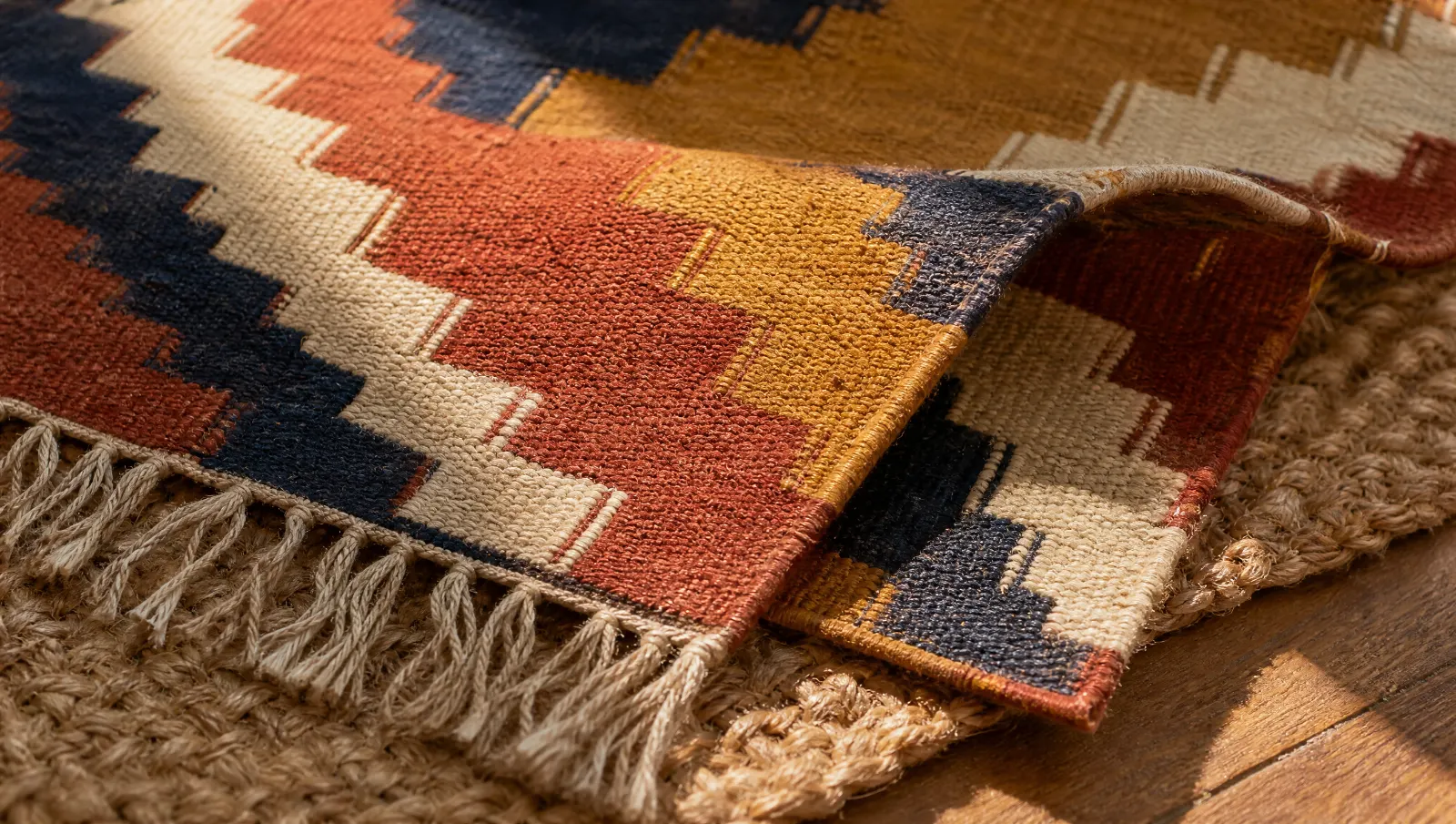
A kilim is a flatweave rug with no pile. Colored weft threads are packed tightly over the warp, and that packed weft forms both the pattern and the surface. Traditional Turkish kilims are wool, sometimes on a cotton warp, woven by hand. Many Anatolian kilims have small vertical slits where two color blocks meet. That comes from the slit-weave technique and is not damage.
- Most are reversible. The pattern shows on both sides, so you can flip the rug to spread wear and fading.
- They are thin, often 1/4 in (5-6 mm) or less. Doors clear them easily, but they slide on hard floors.
- They are light enough to hang on a wall or cut into cushion covers.
- Slits and fringe can snag on cat claws and robot vacuum brushes.
For where kilims sit in Turkish decorating as a whole, see our Turkish decor guide. This post stays on the rug.
Vintage, new or machine-made: what you are actually buying
These are rough, typical price ranges for a rug around 5×8 ft (150×240 cm), not quotes.
- Machine-made “kilim-style” rugs: often $50 to $250, printed or machine-woven, frequently synthetic.
- New handwoven kilims: commonly a few hundred dollars up to about $2,000.
- Vintage kilims: from around $200 for a small worn piece to several thousand for a large, well-kept older one.
The quickest check for a fake is the back. On a real flatweave the pattern shows on the reverse as clearly as on the front, because the colored threads run all the way through. A printed rug has a pale or blank back. That proves a rug is woven, not that it was woven by hand, so look at the fringe too. On a handwoven kilim the fringe is the warp threads coming out of the rug itself; on many machine-made rugs it is a strip sewn onto the end.
My view, and it is only a view: for a kitchen or a house with a big dog, a new or machine-made flatweave is the sensible buy. Keep the vintage piece for a room where it gets looked at more than walked on.
Kilim size and placement by room
Handwoven kilims rarely come in exact standard sizes. A “5×8” might measure 5 ft 3 in by 8 ft 5 in. Mark the outline on the floor with painter’s tape before you buy, especially online.
| Room | Placement | Typical size | Notes |
|---|---|---|---|
| Living room, large | All legs on | 9×12 ft (275×365 cm) | 12-18 in of floor at walls |
| Living room, medium | Front legs on | 8×10 or 6×9 ft | Thin rug, so little tilt |
| Living room, small | Floating | 5×8 ft | Nearly touching the sofa |
| Bedroom, queen | Under bed, crosswise | 8×10 ft | About 30 in (75 cm) each side |
| Bedroom, king | Under bed, crosswise | 9×12 ft | About 34 in (85 cm) each side |
| Bedroom, beside bed | Each side or at foot | 2×3, 3×5 ft or runners | Cheapest option |
| Hallway | Centered runner | 2.5 ft wide | 3-6 in of floor each side |
| Kitchen | Along counters | 2.5×6 ft runner | Pad essential; avoid wet spots |
| Wall | Batten or rod | Small to medium | Out of direct sun |
Living room layouts: legs on, front legs on, or floating
Living room kilims are usually too small. A 5×8 under a large sectional looks like a bath mat.
All legs on. The whole seating group stands on the rug. It needs the biggest rug, and 12 to 18 in (30-45 cm) of bare floor at the walls so it doesn’t read as carpet.
Front legs on. Front legs on the rug, back legs on the floor. A thick pile rug can make a sofa rock slightly this way. A kilim is thin enough, even with a pad, that the tilt is hard to notice, so this layout suits flatweaves well.
Floating. Only the coffee table stands on the rug. It suits small rooms, but coffee tables usually sit 14 to 18 in from the sofa, so the rug should nearly reach the sofa’s front edge.
Bedrooms, hallways and kitchens
Under the bed. Lay the rug crosswise so the lower two-thirds of the bed sit on it, stopping short of the nightstands. An 8×10 under a queen (60 in wide) leaves about 30 in each side for bare feet in the morning.
Beside the bed. Two small kilims or runners cost far less than one large rug and are easy to rotate. For a whole bedroom scheme, our boho bedroom ideas post goes further.
Hallway runners. Leave 3 to 6 in (8-15 cm) of floor each side and stop 6 in or more short of each end. Shoes carry grit into hallways, and grit wears wool, so this is not the place for your best vintage piece.
Kitchen runners. A kilim runner is warm underfoot and hides crumbs. Water is the problem. Wool dries slowly, and a rug that stays damp can grow mildew or bleed dye. Blot spills straight away and keep it clear of the dishwasher drip zone. If the floor by your sink is always wet, a washable cotton flatweave is more practical.
Kilims off the floor: walls, cushions and upholstery
On a wall. A kilim above a sofa or bed does the job of a large artwork. Don’t nail or staple through the weave. The usual method is hook-and-loop tape hand-stitched along the top edge on the back, with the matching strip on a wooden batten screwed to the wall. Nothing shades a wall kilim, so keep it out of direct sun.
Cushions and upholstery. Kilim cushions and ottomans are usually made from fragments of rugs too worn for the floor, a good end for a damaged piece. Opinion: cutting up an intact vintage kilim for cushions is a waste. Seat upholstery is a job for an upholsterer, and a kilim seat shows wear sooner than a floor rug.
Pulling color from the rug, modern furniture and layering
The reliable approach is to take the room’s colors from the rug, in roughly the proportions the rug uses them.
- Ground color for big surfaces. An ivory ground pairs with a warm off-white wall. If the ground is madder red, keep walls quiet and leave the red on the floor.
- Main colors for fabric. Pull one, such as indigo or rust, into curtains or a throw.
- Accents for small objects. A saffron yellow used sparingly in the rug suits a vase or a single cushion.
- Browns for wood. Match wood furniture to the dark brown outlines rather than to the reds.
With modern furniture. Kilim motifs are geometric, mostly diamonds and stepped hooks, so they sit well in modern rooms. A clean-lined sofa in solid fabric and a glass or slim metal coffee table let the pattern show. The usual mistake is quantity: one kilim plus a patterned cushion is plenty, and patterned curtains on top make the room loud. Our Turkish home decor styling guide covers mixing Turkish pieces with modern furniture.
Layering over jute or sisal. A natural-fiber rug fills the floor at the size the room needs, and a smaller, cheaper kilim goes on top, such as a 5×8 on an 8×10 jute. Leave at least 12 in (30 cm) of the base rug showing, or angle the kilim slightly. Jute is softer; sisal is scratchier and water-spots easily. Layering adds a trip edge, so pad or tape the top rug in walkways.
Rug pads and kilim care
Kilims slip. On hardwood or tile, a thin kilim without a pad will creep and bunch until someone slides on it. Use a thin natural rubber or felt-and-rubber pad cut 1 to 2 in (3-5 cm) smaller than the rug on every side. Cheap PVC grip mats can mark some floor finishes, so I’d skip them. On wall-to-wall carpet, use a rug-on-carpet pad or the kilim will walk.
- Vacuum without the beater bar. A rotating brush pulls at the weft and chews fringe. Use suction only, and keep the nozzle off the fringe.
- Rotate and flip every six months or so to even out foot traffic and sun.
- Spot clean fast. Blot, don’t rub. Test a corner with a damp white cloth to check the dyes don’t run, then use cool water with a little wool-safe detergent. Dry it flat. Avoid hot water and steam cleaners.
- Check under furniture. Moths like wool in dark spots that never see a vacuum.
- Leave full washes to a specialist in handwoven rugs.
Lighting that flatters a kilim
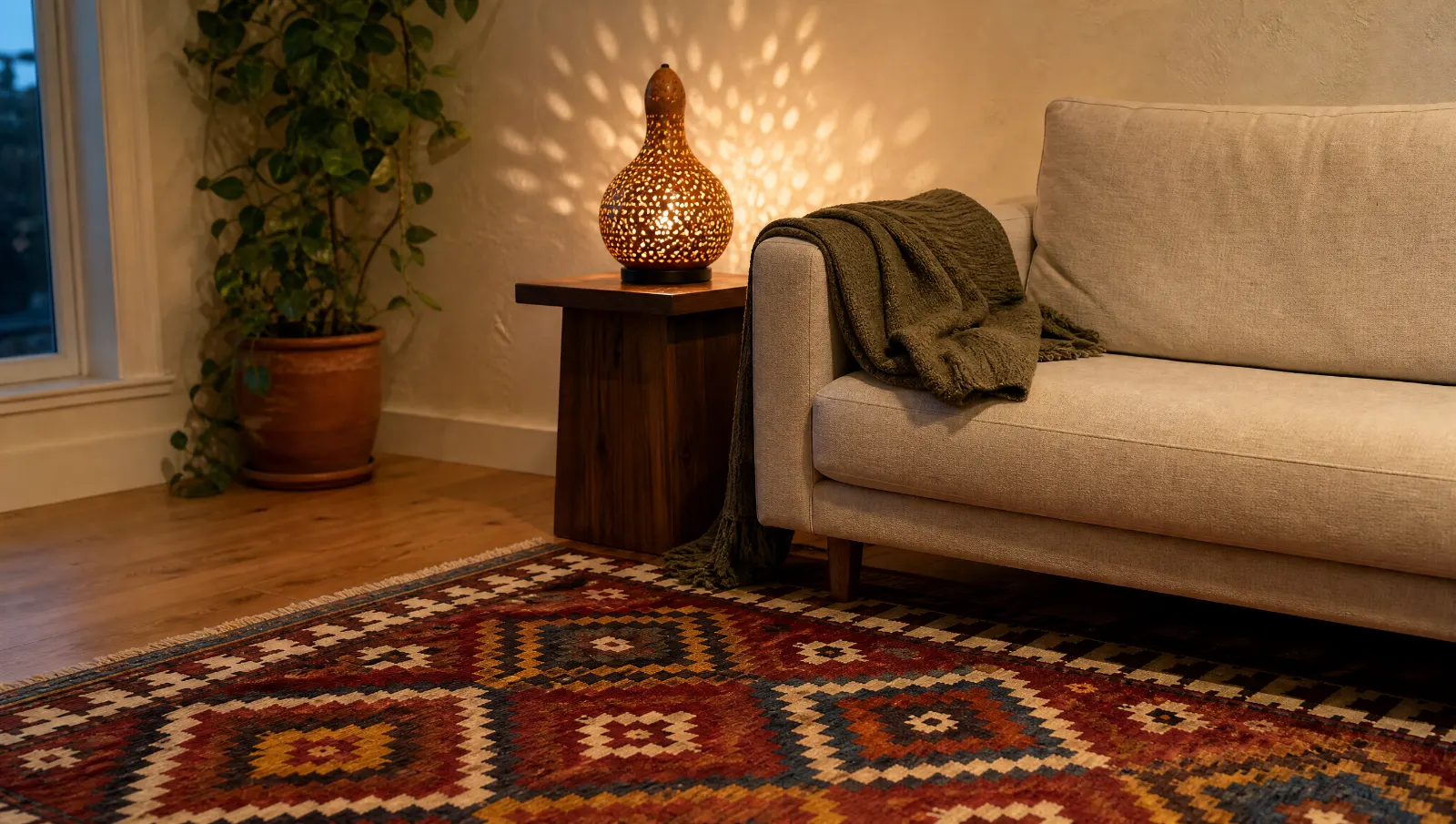
Kilim palettes lean warm, with indigo as the cool contrast, and warm light suits them. Under cool daylight bulbs around 5000K, reds tend to go flat and ivory looks slightly gray. For lamps in a kilim room, 2700K is a safe choice, and a CRI of 90 or higher helps, since low-CRI bulbs are weakest at showing reds. Our guide to bulbs for Turkish lamps covers color temperature in detail.
Low light shows texture. A table lamp beside the rug picks up the ridges of the weave and small shifts in hand-dyed color that a ceiling light washes out.
Sun is the real risk. Direct sunlight fades wool dyes over months and years, and unevenly: the sunny half goes pale while the half under the sofa stays bright. LED bulbs give off almost no ultraviolet, so the window is the problem, not your lamps. Rotate the rug and draw sheer curtains in the brightest hours. UV-filtering film on the sunniest window also helps.
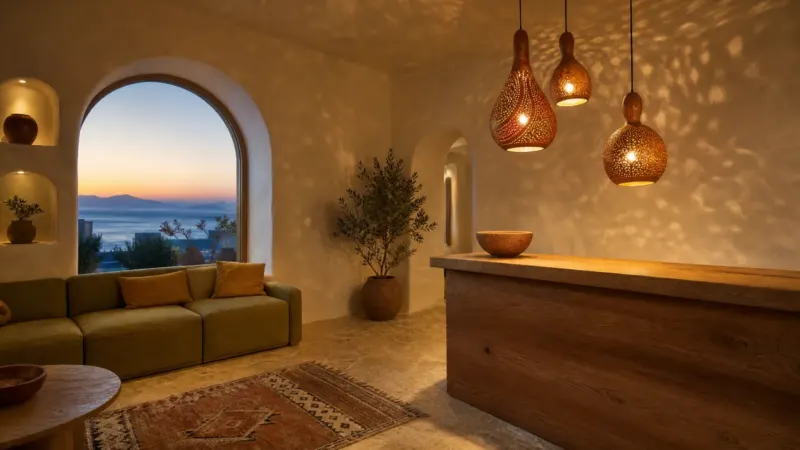
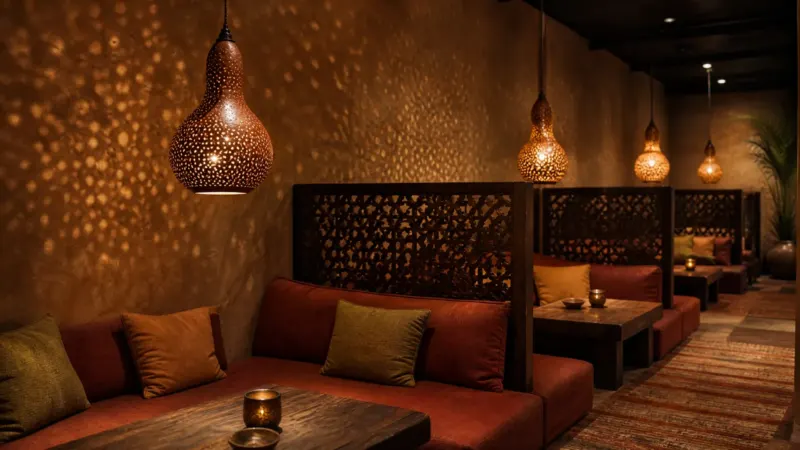
Where a gourd lamp fits. Our carved gourd table lamps throw a dotted pattern of warm light onto walls and ceiling. A Pomegranate Flower gourd table lamp next to a red-ground kilim is a pairing we like. Opinion: pattern on the floor plus pattern on the wall works; pattern on every surface does not. A gourd lamp can’t light a room for reading, since its output is low and patterned, so keep a proper reading lamp by the chair. Gourd dyes also fade in direct sun. Inside one, use a warm white LED of 2200K to 2700K and 4 to 8 W.
Frequently asked questions
Which side of a kilim rug is the front?
On most kilims neither side is strongly the front. The pattern is woven through, so both faces look much alike, and the side with fewer loose thread ends is usually treated as the top.
Do kilim rugs need a rug pad?
Yes, on hard floors. Kilims are thin and light, so they slide on wood and tile. A thin natural rubber or felt-and-rubber pad cut slightly smaller than the rug stops the slipping and reduces wear.
How can I tell if a kilim is handwoven?
Turn it over. A woven kilim shows the pattern clearly on the back, while a printed rug has a pale or blank back. Then check the fringe: on a handwoven kilim it is the warp threads running out of the rug, not a strip sewn on.
What lighting works best with a kilim rug?
Warm light, around 2700K, from lamps placed low and to the side of the rug. It suits the reds and ochres and shows the texture of the weave. Keep the rug out of strong direct sun, which fades the dyes.
Do you sell kilim rugs?
No. GourdLampDecor makes and sells carved gourd table lamps and chandeliers, not rugs. This guide is general advice for decorating around a kilim you own or plan to buy elsewhere.
Where to go next
Our lamps are $279 each with free worldwide shipping, and no gourd matches its listing photo exactly. We can’t take returns, so check photos and dimensions first: table lamps stand 10 to 14 in (25-35 cm) tall. Browse the gourd table lamps, or read our Mediterranean home decor guide if your kilim lives in a lighter, whitewashed room.