Turkish Decor: Living With It Without the Theme-Room Look

Turkish decor has a failure mode, and it is specific: the theme room. Buy six things from the same bazaar stall and a room stops looking designed and starts looking like a restaurant with a name in a script font. The objects are not the problem. The concentration is.
This is about using Turkish pieces in an ordinary home so they read as taste rather than theme. I sell Turkish-made lighting, so I have an interest here, but the advice below is mostly about buying less, not more.
What Turkish decor actually consists of
The tradition is broader than the tourist version suggests. The elements that travel well into a contemporary home:
- Textiles. Kilims, flatweave rugs, suzani embroidery, Turkish towels. The single most useful category.
- Ceramics. Iznik-style blue and white, Kutahya pottery, hand-painted tiles.
- Metalwork. Hammered copper, brass trays, coffee pots.
- Lighting. Mosaic glass, pierced metal, carved organic shells.
- Woodwork. Inlaid boxes, carved screens, olive-wood kitchenware.
Behind all of it is a consistent logic: pattern is dense but the palette is narrow, materials are natural, and everything is made to be used rather than displayed.
A few categories travel less well. Evil eye (nazar) beads in large numbers read as souvenir very quickly; one small piece by a door is traditional, a wall of them is a gift shop. Ornate carved and inlaid Ottoman-style furniture is beautiful and heavy, and in a small modern flat it dominates everything around it. Brass trays on folding stands work if you actually use them as tables.
The one-in-three rule
The most useful discipline I know for this style: no more than one in three visible objects in a room should read as Turkish.
A kilim on a plain floor, a modern sofa, a Turkish lamp on a plain side table. Three pieces, two of them neutral. That reads as a person with taste who has travelled.
The same kilim with a brass tray table, a mosaic lamp, an inlaid box, a copper pot and a tile-topped console reads as a set. The individual objects have not got worse. There are just too many of them saying the same thing.
The rule bends with room size. In a large open-plan space you can go a little higher because the eye takes in zones rather than the whole room at once. In a small bedroom, one strong Turkish piece is often enough. The test is simple: stand in the doorway and count what catches your eye first. If more than a third of those things came from a bazaar, take one away.
It also helps to vary the type of object. One textile, one light and one ceramic reads as a considered room. Three ceramics reads as a collection shelf, which is a different thing.
Colour, which is where most people go wrong
Turkish palettes are more restrained than the souvenir market implies. Traditional Iznik work is essentially cobalt, turquoise, coral red and white. Kilim palettes are earth-based: madder red, indigo, undyed wool, ochre.
The multicoloured rainbow mosaic lamp sold in tourist areas is a modern export product, not a traditional palette. It is a perfectly nice object; it is just not what the tradition looks like. If you want the room to read as considered rather than as a holiday, pick two colours from the piece you love most and let everything else stay neutral.
A practical way to use this: pick your two colours from the most expensive Turkish piece you own, usually the rug, and let every other Turkish object repeat one of them. A kilim with madder red and indigo tells you the lamp should throw warm amber rather than multicoloured glass light, and the ceramics should be blue and white rather than the full Iznik range. Neutral walls in off-white or warm plaster tones give the colours room.
Test the palette before buying anything large. Lay the rug, a cushion and a photo of the lamp together on the floor in evening light, and if the colours fight in the photo they will fight in the room.

Room by room
Living room
A kilim is the highest-value single purchase. It anchors the room, handles wear well, and lets everything else stay plain. Add one light source with pattern and stop.
Bedroom
Textiles over objects. A suzani throw or embroidered cushions on otherwise plain bedding. Low warm light. Keep surfaces clear.
Kitchen
The most naturally suited room, because Turkish kitchen objects are functional. Copper pans, olive wood, a few hand-painted tiles as a splashback detail rather than a full wall.
Bathroom
Turkish towels, and that is genuinely it. Do not put mosaic glass or carved wood anywhere humid.
Hallway
The best place for a single dramatic pierced lamp, because a hallway has no competing function and you pass through rather than sit in it.
Dining room
This is where a Turkish pendant earns its place. One hanging lamp over the table, a plain linen runner and a single copper or ceramic serving piece is a complete look. Keep chairs and table simple. Carved or inlaid dining furniture plus a patterned pendant is too much in most rooms.
Hallway and entrance
A runner-sized kilim handles foot traffic well and hides dirt. A small lamp on a console gives the first impression of the house without the space needing any other decoration. Avoid anything fragile at hip height in a narrow hall.
Buying: what to check
| Item | Good sign | Warning sign |
|---|---|---|
| Kilim | Wool, slight irregularity, visible on both sides | Printed pattern, backing glued on |
| Ceramic | Brush marks, small glaze pooling | Perfect transfer-printed edges |
| Copper | Visible hammer marks, weight | Uniform machine finish, very light |
| Mosaic lamp | Cut glass pieces, uneven grout | Moulded plastic shell with printed pattern |
| Carved lamp | Tool marks, varying wall thickness | Identical holes, heavy for its size |
Price is a signal too, though not a proof. A genuine handwoven wool kilim of about 120 by 180 cm is rarely cheap, and a new one far below a few hundred dollars is worth questioning. Hand-painted Iznik-style tiles cost noticeably more than printed ones. Our own lamps are a single fixed price, $279, which is typical of hand-carved gourd work and a long way above the resin lookalikes.
Ask where and how a piece was made, and listen to how specific the answer is. A seller who can name the town, the workshop or the technique usually knows the product. A seller who answers “Turkey” and nothing more may be reselling something they have never handled.
Fakes and reproductions
Machine-made kilims are the most common reproduction. The quickest check is to look at the back: a real flatweave shows the pattern on both sides. A printed rug shows a blank or coated backing.
For ceramics, hand-painted work has slight asymmetry in the linework and tiny variations in glaze thickness. Transfer prints are perfectly even, and the edges of each colour are unnaturally crisp.
For lamps, the check depends on the type. Mosaic glass lamps from a real workshop show small irregularities in the gaps between pieces; factory lamps have gaps that are too even. Carved gourd lamps should be very light for their size and show natural variation in shell colour. The checks in what to check before buying Turkish lamps go through plugs, packing and duty as well.
What Turkish decor will not do
It will not make a room feel finished on its own. It is a layer, not a scheme.
Most of it does not belong in humid rooms. Wool, wood, dried gourd and plaster-set mosaic all react badly to sustained damp.
And handmade pieces will not match each other. Two kilims from the same region will not share a palette exactly. Two carved lamps will not be the same shape. Buying handmade means giving up on matching, which is the point but is worth knowing before you order two of something.
It will not match the photo either. Handwoven rugs vary in colour between dye batches, hand-painted ceramics vary piece to piece, and our gourd lamps vary in shape and shell colour because every gourd grows differently. If exact matching is important to you, Turkish handmade is the wrong category. Machine-made pieces in a Turkish style will give you consistency, and there is nothing wrong with choosing that.
Lighting: where a Turkish lamp fits
Lighting is the part of Turkish decor that does the most work for the least space. A rug covers a floor. A lamp changes the whole room after dark by putting pattern on the walls and ceiling, and it takes up about 25 cm of table top.
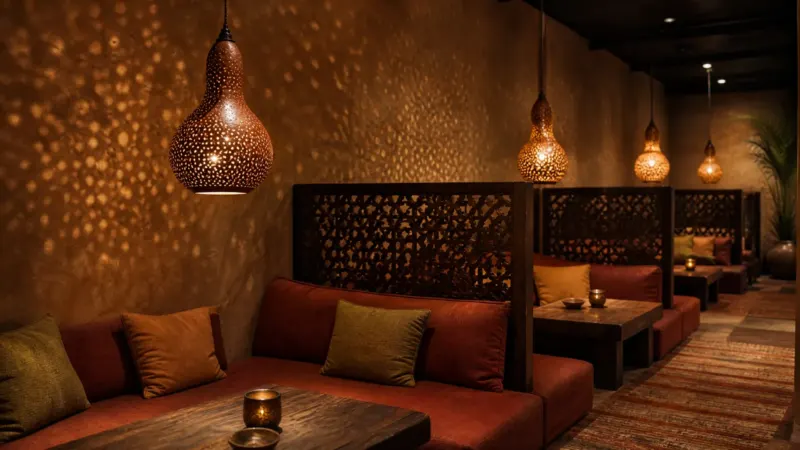
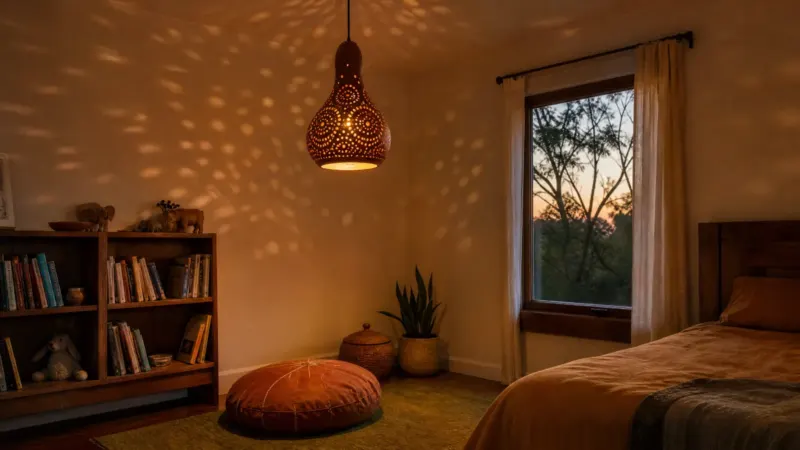
The two main choices are coloured mosaic glass and carved gourd. Mosaic glass throws spots of colour, which suits a room with a restrained palette that can take one burst of colour. Carved gourd throws warm amber dots with no added colour, which suits a room that already has a busy rug or textiles. That is the whole decision for most homes, and gourd lamps versus Turkish mosaic lamps goes through it in detail.
Placement matters more than the lamp. Put it where the wall behind it is plain, so the pattern has somewhere to land. A lamp against a bookshelf or a gallery wall loses most of its effect. If you want a concrete example of the warm-amber route, the Pomegranate Flower gourd table lamp uses a traditional Anatolian motif without any added colour.
One honest limit: neither type is a reading light. Pair it with a plain task lamp where you actually read.
Frequently asked questions
How do I use Turkish decor without it looking like a theme room?
Keep it to about one in three visible objects, hold the palette to two colours, and let the rest of the room stay neutral. Concentration is what creates the theme-room effect, not the objects.
What is the best first Turkish piece to buy?
A kilim. It anchors a room, wears well, and lets everything else stay plain.
Are the multicoloured mosaic lamps traditional?
Not really. Traditional Turkish palettes are narrow – cobalt, turquoise, coral and white, or earth tones in weaving. The rainbow mosaic lamp is a modern export product.
How can I tell a real kilim from a printed one?
Look at the back. A real flatweave shows the pattern on both sides. A printed rug has a blank or coated backing.
Does Turkish decor work in a small flat?
Yes, and arguably better, because the one-in-three discipline is easier to hold when there are fewer surfaces. Choose textiles and one light source.
Can Turkish pieces go in a bathroom?
Towels yes. Wool, wood, mosaic glass and carved gourd no – humidity damages all of them.
What is the best Turkish decor piece to start with?
A flatweave kilim if you want one piece that changes the whole room. A Turkish lamp if you want the biggest change after dark in the least space. Start with one and live with it for a few weeks before adding more.
Does Turkish decor work with modern furniture?
Yes, and usually better than with ornate furniture. Plain modern sofas, tables and walls give Turkish textiles, ceramics and lamps a calm background, which is exactly what stops the room looking like a theme set.
Related reading
For the styling side in more depth, see Turkish home decor without the souvenir-shop look. On lighting specifically, the Turkish lamps buyer’s guide covers the categories and what a Turkish mosaic lamp is explains the glasswork. For how carved gourd differs from mosaic, read gourd lamps versus Turkish mosaic lamps, and telling real craft from a factory copy covers the verification checks across categories.