Mediterranean Home Decor: Regions, Materials and Lighting

Mediterranean home decor gets sold as one look, usually a white wall and a blue door. Around the actual sea it is several looks that share a climate. We make carved gourd lamps in a workshop in Bodrum, on Turkey’s Aegean coast, so we live inside one version of it and ship lamps into the others.
This guide covers the regional styles, the materials and colors that do the work, lighting, and how to avoid the themed-restaurant look.
What Mediterranean home decor means in practice
Strip away the postcards and a few habits show up in almost every Mediterranean house, from Crete to Andalusia. They come from hot summers and local materials, and they travel to a house in Ohio far better than souvenirs do.
- Matte, textured walls: lime plaster or limewash instead of flat, even paint.
- Hard, cool floors: terracotta tile or stone, softened with a flat-woven rug.
- Natural fibers: linen, cotton, wool, rush and jute.
- Fewer, heavier pieces of furniture: wood, iron and built-in masonry rather than upholstered bulk.
- Handmade objects in daily use: ceramic bowls, olive wood boards, copper pans.
- Low, warm light from several small sources at night.
Everything past that list is regional. A Greek island house and a Tuscan farmhouse share those habits and little else, which is why a room mixing both tends to go wrong.
Regional Mediterranean styles compared
Five versions come up most often. The table simplifies, but it is enough to pick a direction before you buy paint.
| Style | Palette | Materials | Signature pieces | Lighting |
|---|---|---|---|---|
| Greek island (Cyclades) | Whitewash, cobalt or sea blue, sand | Lime plaster, painted wood, stone or pebble floors | Built-in plaster benches, painted shutters, simple wooden chairs | Plain wall lights, lanterns, bare warm bulbs |
| Italian / Tuscan | Ochre, sienna, olive, faded terracotta | Terracotta tile, travertine, timber beams, wrought iron | Long farmhouse table, iron bed, painted majolica plates, clay oil jars | Iron chandeliers, candle-style sconces, linen-shaded table lamps |
| Spanish / Andalusian | White walls, terracotta, deep green, tile blues and yellows | Terracotta floors, painted ceramic tile, dark carved wood, iron window grilles | Tiled stair risers, carved chests, courtyard pots | Pierced iron lanterns, iron wall sconces |
| Turkish Aegean coast | White or chalky walls, blue trim outside, madder red and copper inside | Stone, lime plaster, kilims, copper, painted ceramics | Low sedir bench seating, kilim cushions, copper trays | Carved gourd lamps, pierced metal lanterns, mosaic glass pendants |
| Moroccan influence | Saffron, rust, indigo, deep teal, brass | Tadelakt plaster, zellige tile, carved cedar, brass | Leather poufs, carved screens, low tables, layered rugs | Pierced brass lanterns, colored glass lamps |
From Bodrum, the Turkish row is home turf. The houses in town are white cubes with blue window frames, which is why the Greek and Turkish coasts get confused in photos, but older interiors usually run warmer, with madder-red kilims and old copper. Our Turkish home decor styling guide covers that look room by room. The Moroccan row overlaps heavily with Turkish lighting, and our comparison of Moroccan, Turkish and boho lamp styles sorts out which lamp belongs where.
The materials that carry the look
If the budget only stretches to a few changes, spend it on surfaces rather than accessories. A limewashed wall and a terracotta floor read Mediterranean with almost nothing else in the room.
Lime plaster and limewash
Real lime plaster is a job for a plasterer and develops small cracks over the years, which is part of its appeal. Limewash paint gets you most of the cloudy finish in a weekend. On drywall or painted walls it usually needs a particular mineral primer, so read the maker’s instructions first.
Terracotta and stone
Terracotta tile is porous and normally sealed. Travertine and limestone etch under lemon juice and vinegar, which surprises people who chose them for a Mediterranean kitchen. Porcelain tile in a terracotta or limestone finish gives the color without the upkeep.
Linen, olive wood and wrought iron
Linen wrinkles, and in this style that is fine. Olive wood boards and bowls are the affordable way in; hand wash and oil them, and keep them out of the dishwasher. Wrought iron works in thin, small amounts, such as a curtain rod or a bed frame. Heavy iron on every surface starts to feel like a steakhouse.
Ceramics
Hand-painted ceramics bring most of the pattern. Pick one family, say Spanish tile blues or Turkish red and cobalt, and concentrate it in one or two places, such as a backsplash or a wall of plates. Single pieces scattered through every room dilute it.
Two palettes: whitewash and blue, or terracotta and ochre
Nearly every Mediterranean room falls into one of two color families. Choose early, because the choice decides your paint and your lamps.
Whitewash and blue is the Greek island look: warm white walls, a single blue, natural wood and sand-colored linen. It needs strong daylight. In a sunny room it looks crisp. In a north-facing room under a gray sky, bright white and cobalt can turn cold and flat. Opinion: in a dim climate, choose a creamy off-white and a grayed, softer blue.
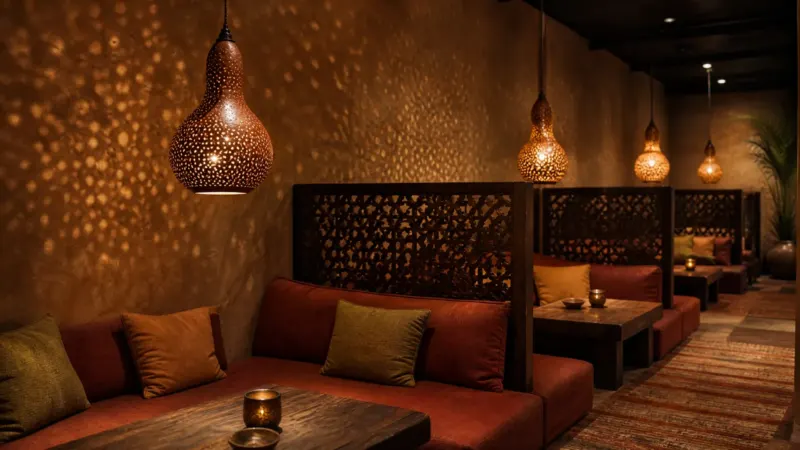
Terracotta and ochre is the Tuscan, Andalusian and inland Turkish look: cream or pale ochre plaster, terracotta underfoot, olive green, rust and darker wood. It is more forgiving. It stays warm under gray skies and takes lamplight well, because the walls bounce amber back into the room.
You can borrow across the line in small doses. A terracotta room with one blue-and-white bowl looks collected. A room split evenly between cobalt and ochre looks undecided.

Furniture: fewer pieces, heavier materials
Mediterranean rooms look sparse in photos mostly because there is less furniture, and each piece has real weight.
- Seating: a slipcovered linen sofa in sand or oatmeal, or a built-in bench with loose cushions if you are renovating. The sedir in older Turkish homes is exactly that kind of low wall bench.
- Tables: a thick-topped wooden dining table that looks used.
- Chairs: woven rush or cord seats, or painted wood for the island version.
- Storage: open shelves for everyday ceramics and a carved or painted chest.
- Beds: wrought iron or plain wood, dressed in washed linen.
Avoid matching sets. A dining set from one delivery looks like a showroom in any style, and worst in this one, where the charm comes from pieces that belong to different decades.
Plants and the indoor-outdoor habit
Mediterranean houses lean outward, toward courtyards and terraces. Indoors, the plants people want most are the ones that struggle there.
Olive trees need several hours of direct sun, and in an average living room a potted olive tends to drop leaves over winter. Lemon trees and rosemary behave much the same. If your light is ordinary, cut olive branches in a clay jug look right and ask nothing of you.
Pots matter as much as plants. Unglazed terracotta in mixed sizes, grouped on the floor, does more for the look than a rare plant in a plastic nursery pot. Clay dries out faster, so water more often, and use saucers, since damp clay can mark a wooden floor.
Lighting: warm, low and from several places
This is where most Mediterranean rooms go wrong. The houses keep the sun out by day, and at night they are lit by small, warm sources at different heights. A single bright ceiling fixture flattens textured plaster and drains the warmth out of terracotta.
- Color temperature: warm white, 2200K to 2700K, anywhere you sit in the evening.
- Height: mix a pendant with lamps at table height and a lantern near the floor.
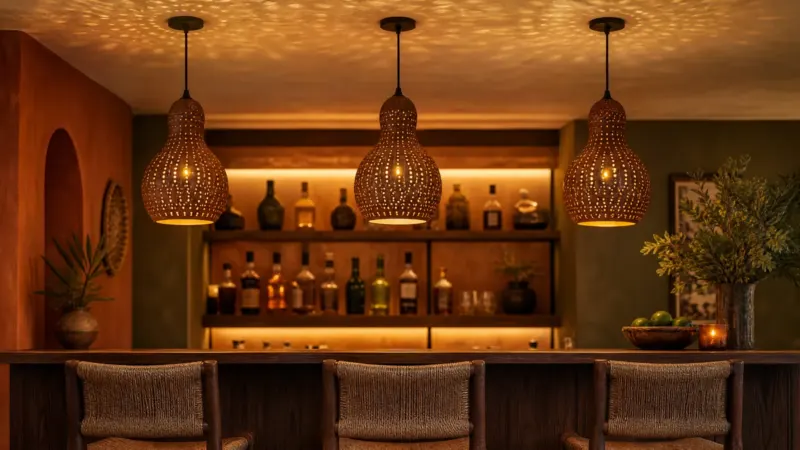
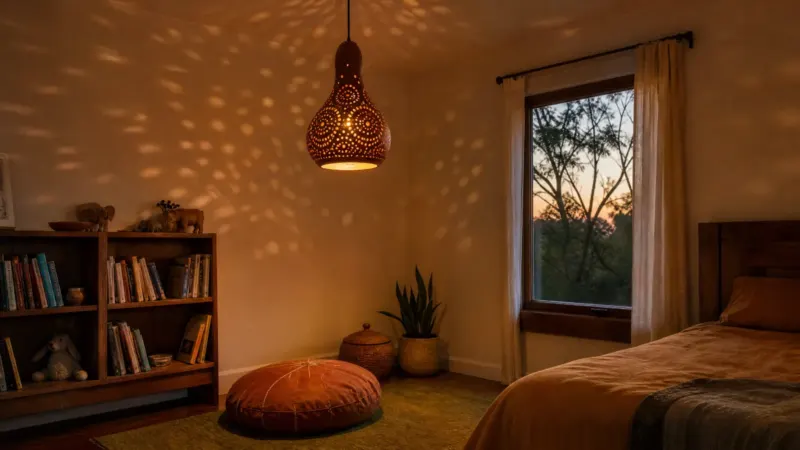
- Pattern: pierced and carved lamps suit plaster, because the texture catches dotted light. Our guide to bulbs for Turkish lamps explains why a 4-8 W warm LED works best inside a carved shade.
- Task light: kept separate and plain.
To be clear about what we sell: carved gourd table lamps and hanging lamps only, no metal lanterns, mosaic glass lamps or floor lamps. A gourd lamp gives patterned, low light, so it is no help for reading or chopping onions.
For hanging pieces, check your ceiling height first. Our hanging models come with an 80 cm (32 in) cable, which suits a dining table under an 8 ft ceiling and is short for anything taller. The guide to hanging Turkish lamps covers drop heights, swag hooks and when to call a licensed electrician.
How to avoid the theme-restaurant look
The failure mode of Mediterranean decor is the chain restaurant: sponge-painted “aged” walls, plastic grapes and a harbor mural.
- Pick one region and let one neighbor in. Tuscan with some Spanish tile works. Greek, Tuscan and Moroccan in one room does not.
- Keep about two-thirds of the room quiet. Pattern goes in a rug, a backsplash or one lamp, not all of them at once.
- No motif words. Skip signs and anything with “Tuscany” or “Santorini” printed on it.
- Skip imitation finishes. Faux-marble paint and resin columns read false from across the room.
- Use real objects. Bowls you eat from and a board you cut on. Things that exist only to announce “Mediterranean” tip a room into theme.
If the Turkish end of the Mediterranean is where you are heading, our Turkish decor guide is the better starting point.
Where gourd lamps fit, and where they don’t
Candidly, our lamps suit the warm-earth versions far better than the blue-and-white Greek look. A natural gourd shell is amber to brown, and the light through it is warm and dotted. In a crisp white room with cobalt shutters, a brown gourd tends to look like a souvenir carried home in someone’s luggage.
If you are set on whitewash, the White gourd is the closer fit; every design comes in Natural or White. It still throws warm light. My view, and it is only a view: one white gourd in a white room works, and three crowd it. If you love your room cool and blue, a plain linen-shaded lamp may serve it better than anything we make.
For the warm versions, a pomegranate pattern is an easy choice, since the fruit turns up in Turkish, Greek and Spanish ornament alike. The Pomegranate Gourd Table Lamp sits well on a wooden side table against plaster. Every lamp is $279 with free worldwide shipping, made in 5-7 days and typically delivered in 2 weeks.
Before ordering, know this. Each gourd grows differently, so yours will not match the listing photo exactly. Gourd lamps do not belong in bathrooms or on an uncovered terrace; a covered porch is fine. The supplied switch is on/off only. A table lamp gourd is 7.5-9 in (20-23 cm) across. Because we can’t take returns, look at the photos and dimensions carefully first.
Frequently asked questions about Mediterranean home decor
What colors are used in Mediterranean home decor?
Two families cover most rooms. The Greek island version uses warm white, one blue and natural wood. The Tuscan, Spanish and inland Turkish versions use cream or ochre plaster with terracotta, olive green and rust. Pick one family as the base.
Is Mediterranean decor the same as Tuscan decor?
No. Tuscan is one regional version, with ochre walls, terracotta floors, timber beams and wrought iron. Greek island, Spanish, Turkish coastal and Moroccan-influenced rooms share the natural materials but use different colors and pieces.
How do I make Mediterranean decor look modern?
Keep the materials and drop most of the ornaments. Limewashed walls, a terracotta or stone-look floor and washed linen read as current. Faux paint finishes and grape motifs date a room quickly.
What lighting suits a Mediterranean room?
Several warm, low sources instead of one bright ceiling light: 2200K-2700K bulbs, table lamps, a pendant and perhaps a lantern. Add a plain lamp for reading, because pierced and carved lamps give low light.
Can I use a gourd lamp in a blue and white Mediterranean room?
You can, but gourd lamps fit warm terracotta and ochre rooms better. In a white and blue room, choose the White gourd option and use a single lamp as an accent.
Where next
For the Turkish side in depth, read the Turkish home decor styling guide. If the warm-earth version suits your home, browse our gourd chandeliers and pendant lights.