Mediterranean Kitchen Decorating: Tile, Shelves and Lighting

Mediterranean kitchen decorating works best when you start with the surfaces and finish with the objects. Tile, wood, stone and light carry most of the look. A bowl of lemons helps, but it can’t rescue shiny gray laminate under one bare ceiling bulb.
We make carved gourd lamps in a small workshop in Bodrum, on Turkey’s Aegean coast. One opinion you might not expect from a lamp seller: our lamps don’t belong near the cooking. For the style across the whole house, see our Mediterranean home decor guide. This post stays in the kitchen.
Mediterranean kitchen decorating: surfaces first, objects last
The style borrows from kitchens around the sea, from the Greek islands and southern Italy to the Turkish Aegean and coastal North Africa. They share two habits worth copying: materials that look better with wear, and displays made of things people use daily.
- Pick one hero surface: a patterned floor, a zellige-style backsplash or a stone counter.
- Keep the other surfaces quiet, with plain or limewashed walls.
- Decide what storage stays open and what goes behind doors.
- Plan lighting by zone, task light before pendants.
- Add objects last: ceramics, copper, herbs, linen.
For color, use warm white or cream with terracotta and olive. Opinion: one strong blue accent is plenty. Blue tile plus blue cabinets starts to look like a themed taverna.
Tiles: zellige-style, patterned cement and terracotta
Tile gives most Mediterranean kitchens their character, and it is the most expensive thing to change later. Each common type has a maintenance trade-off.
Zellige and zellige-style tile. Traditional zellige is handmade glazed clay tile from Morocco, with uneven faces and color that shifts from tile to tile. Zellige-style tiles are factory-made ceramic or porcelain imitating the look, cheaper and more even in size. Ask your supplier whether their tile needs sealing, since chipped edges can soak up oil.
Patterned cement tile. Cement (encaustic) tiles are pressed from pigmented cement rather than fired. They make handsome floors and backsplashes, but they’re porous. They need sealing at installation and resealing over the years, and lemon juice or vinegar can dull them. Porcelain tiles printed with cement patterns avoid the upkeep but look flatter up close.
Terracotta. Unglazed terracotta is the warmest kitchen floor there is. It’s porous too, so it gets sealed, and dropped oil can still mark it. If you want a floor that always looks new, pick something else.
Opinion: use one patterned tile per kitchen. Two busy patterns fight each other.
Wood and stone surfaces that age well
This style tolerates wear. A marble counter with etch marks or a table with knife scars looks right here, which is lucky, because both will happen.
- Marble, limestone and travertine are calcium-based, so lemon juice or vinegar etches dull marks into them. A honed (matte) finish hides etching far better than polished. Sealing helps with stains, not etching.
- Granite resists acids and still reads as natural stone, though it looks busier. Some stone sold as quartzite behaves like marble, so test a sample with lemon juice.
- Butcher block is warm and kind to knives. It needs regular oiling with a food-safe oil, and standing water at a sink edge will damage it, so many kitchens put stone around the sink and wood elsewhere.
For walls, limewash or a plaster-look paint gives the soft surface of older coastal houses. Behind the stove, use tile or stone that wipes clean.
Open shelving with ceramics you actually use
Open shelves are the most photographed part of a Mediterranean kitchen and the part people most often regret. The problem is grease: cooking puts a fine film of oil into the air, and it settles near the stove and holds dust.
- Keep shelves away from the range. A wall near the table stays far cleaner than the wall beside the cooktop.
- Display what you use every day. Plates that go through the dishwasher stay clean. The platter nobody touches turns tacky.
- Group by color. Cream stoneware with a few terracotta pieces reads calm. A dozen patterns reads like a market stall.
- Anchor brackets into studs. A 3 ft (91 cm) shelf of stoneware is heavy. A depth of 10-12 in (25-30 cm) holds dinner plates.
Handmade pottery suits the style. If you’ll eat from painted pieces, buy from sellers who state the glaze is food safe, because some pottery is sold for decoration only. Our Turkish home decor styling guide covers mixing Anatolian ceramics with textiles elsewhere in the house.

Copper, brass, herbs and olive oil as decor
These objects make a kitchen read as Mediterranean from the doorway, and they look best as working items.
Copper and brass. A few copper pans on a wall rail add warm color beside terracotta and wood. Copper cookware is normally lined with tin or stainless steel. Old market finds may be unlined or worn through, and unlined copper shouldn’t hold acidic food, so treat those as decor. Unlacquered brass pulls and taps darken with handling; lacquered brass stays bright until the lacquer wears.
Herbs. Rosemary, thyme, oregano and basil mostly want a lot of sun. A bright south- or west-facing window (northern hemisphere) can keep them going. In a dim kitchen the potted rosemary becomes a brown twig within weeks, so buy cut herbs for a jar of water instead.
Olive oil. A tall bottle beside the burners is a classic image and a poor storage habit. Light and heat both degrade olive oil. Keep the main supply in a tin or dark bottle in a cool cupboard, and fill a small counter pourer with a week or two’s worth. Set it by the prep area, not above the cooktop.
Cheap extras, such as a bowl of lemons or a garlic braid, are easy to swap when you tire of them.
The rustic table and the space around it
Many Mediterranean kitchens are really kitchens with a table in them, and the table does more for the look than any tile. Look for solid or reclaimed wood with a scrubbable top, with rush-seat chairs or a bench along the wall.
Clearances matter more than style. Common planning figures:
- At least 36 in (91 cm) from table edge to wall or counter so chairs pull out.
- 42-48 in (107-122 cm) where people walk behind seated diners.
- About 24 in (61 cm) of table edge per person.
In a small kitchen, a breakfast nook with a built-in bench gives the same feel in less space, and the bench side needs no pull-out room.
Kitchen lighting: task light first, then pendants
Kitchen lighting goes wrong when the pretty pendant comes first and the owner ends up chopping onions in their own shadow. Plan it in this order.
1. Task light over counters. Under-cabinet LED strips are the most useful light in a kitchen with upper cabinets. Mount them toward the front of the cabinet underside so light lands on the work surface. With a glossy zellige backsplash, choose strips with a diffuser, because bare LED dots reflect in glazed tile as bright spots. With open shelving and no uppers, place ceiling fixtures over the counter’s front edge. A fixture mid-room throws your shadow onto the board.
2. Stove and sink. The range hood light covers the cooktop. Over the sink, a recessed light or a closed fixture that wipes clean is the usual answer.
3. General light. Ceiling lights on a dimmer, for cleaning up and walking in at night.
4. Decorative pendants. Hang the bottom of a pendant about 30-36 in (76-91 cm) above an island or tabletop in an 8 ft (244 cm) room, a little higher under taller ceilings. Over an island, a common starting point is 24-30 in (61-76 cm) between pendant centers. Our guide on how to hang Turkish lamps covers drop heights by room and plug-in versus hardwired.
Put each layer on its own switch. Many people choose 2700K-3000K for warm task lighting, and a high color rendering index (CRI 90 or above) makes food look like food.
| Kitchen zone | Right light | Task or decorative | Carved gourd lamp here? |
|---|---|---|---|
| Counters and prep area | Under-cabinet LED strips, or ceiling fixtures over the counter edge | Task | No, output too low |
| Stove or cooktop | Range hood light | Task | No, grease and heat |
| Sink | Recessed light or a closed fixture that wipes clean | Task | No, steam and splashing |
| Island used for prep or with a cooktop | Pendants that throw light downward, plus recessed lights | Task and decorative | No |
| Island used only for eating | Pendants 30-36 in (76-91 cm) above the counter | Decorative | Maybe, if the range is well away |
| Dining table or breakfast nook | Pendant 30-36 in (76-91 cm) above the table | Decorative | Yes, the best spot |
| Whole room | Ceiling lights on a dimmer | General | No |
Where a carved gourd lamp fits in a kitchen, and where it doesn’t
We sell carved gourd lamps, so here is the part a lamp seller would normally skip. A gourd lamp is not a kitchen task light, and it doesn’t belong above a stove or a sink.
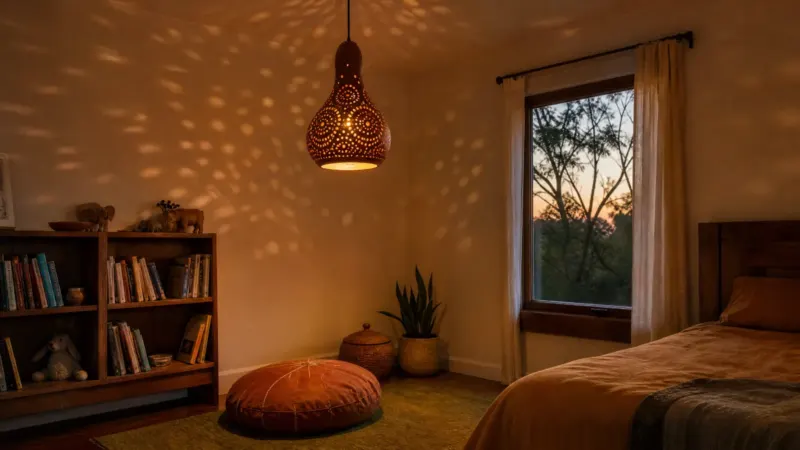
Light leaves through carved holes, so output is low and dotted: fine for atmosphere, useless for dicing garlic. Over a cooktop, grease carried in the steam settles on the shell and inside every hole while heat rises straight into it. You can’t wash a gourd lamp either. Care means a dry soft brush with no water or spray cleaners, and a brush won’t shift a sticky film. Over a sink you add splashing water, which our lamps aren’t made for.
Where one does work:
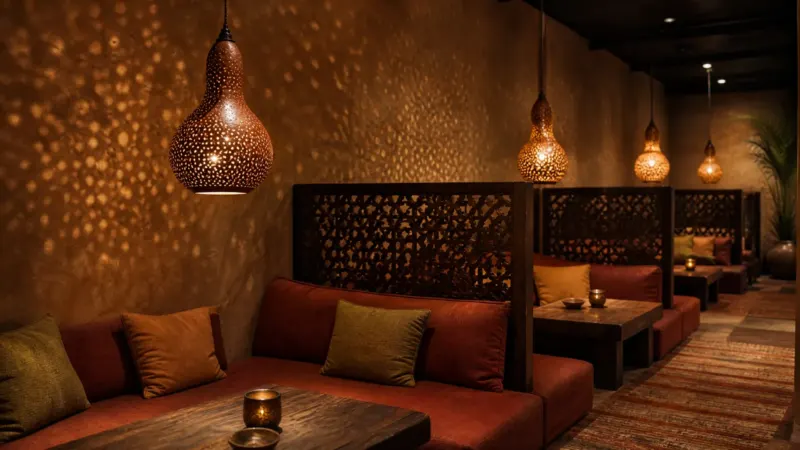
- Over a dining table or breakfast nook away from the cooking zone. A hanging gourd lamp there throws patterned light across the wall while you eat. Our Lotus Flower gourd chandelier is one option over a nook table.
- A table lamp on a sideboard in the eating area, well clear of the stove, where its 2 m (78 in) cable reaches an outlet.
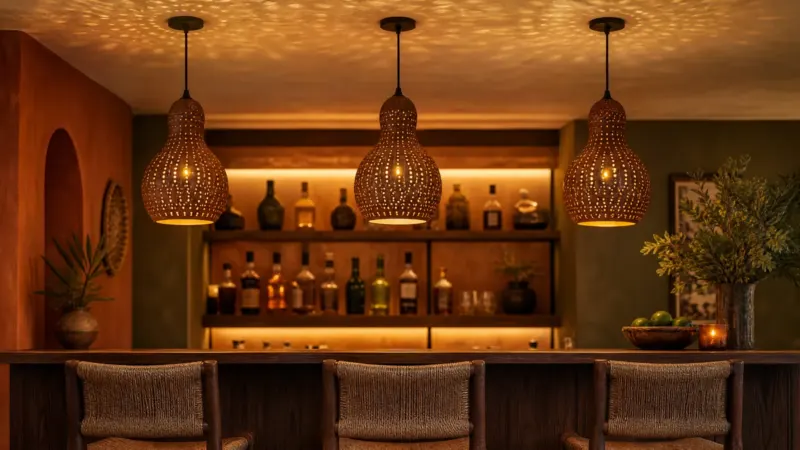
- Over an eating-only island, possibly, if the range is across the room. Opinion: even then I’d rather hang it over the table.
Check the limits before you order. Hanging models come with an 80 cm (32 in) cable, enough over a table in an 8 ft room but short under higher ceilings, so plan a longer cord or an electrician. The switch is on/off; dimming needs a dimmable bulb and a compatible dimmer. Use a warm white LED of 2200K-2700K and 4-8 W, as our bulb guide for Turkish lamps explains. Every gourd differs, so yours won’t match the listing photo exactly. Because we can’t take returns, look at the photos and dimensions carefully first.
When not to buy one for a kitchen: if the only free spot is above the stove or sink, or if you want a pendant to light your prep. Spend the money on under-cabinet lighting instead.
Frequently asked questions
What colors work best in a Mediterranean kitchen?
Warm white or cream walls with terracotta, ochre and olive, ideally coming from tile and clay rather than paint. Blue works as a single accent if you like the Greek or Turkish coast look.
Are cement tiles a good idea in a kitchen?
They can be, if you accept the upkeep. Cement tiles are porous, need sealing and periodic resealing, and acids can dull them. Porcelain tiles printed with cement-tile patterns need far less care.
How high should pendant lights hang over a kitchen island?
A common starting point is 30-36 inches (76-91 cm) from the counter to the bottom of the pendant in an 8 ft room, a little higher under taller ceilings.
Can I hang a gourd lamp over my stove or kitchen island?
Not over a stove or a sink. Grease in cooking steam coats the carved shell, and a gourd lamp can’t be washed. An eating-only island far from the range can work, but a dining table or breakfast nook is the better spot.
Do I need to renovate to get a Mediterranean kitchen look?
No. Brass cabinet pulls, one wooden shelf of everyday ceramics away from the stove, a rustic table with linen and warm bulbs get you a long way without new tile or counters.
Where to go next
For the same style beyond the kitchen, read our Mediterranean home decor guide, and before hanging anything over a table, the hanging guide. For a breakfast nook pendant, the gourd chandeliers and pendant lights category has all 13 designs, each $279 with free worldwide shipping, made in 5-7 days and typically delivered in 2 weeks.