Gourd Table Lamps: What They Do and What They Do Not

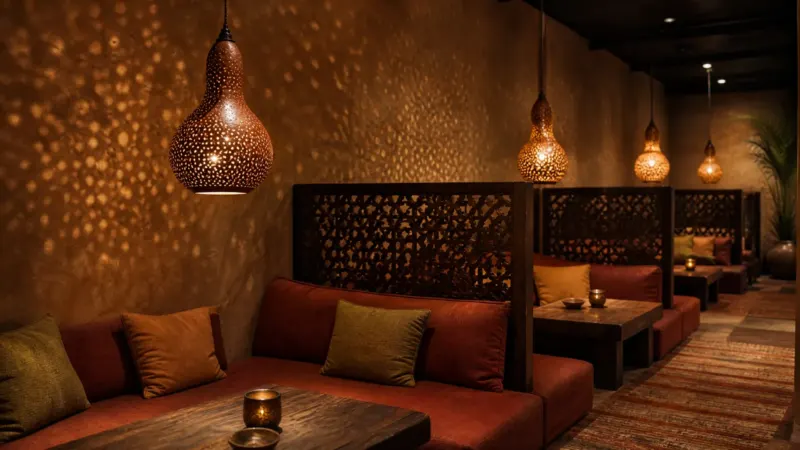
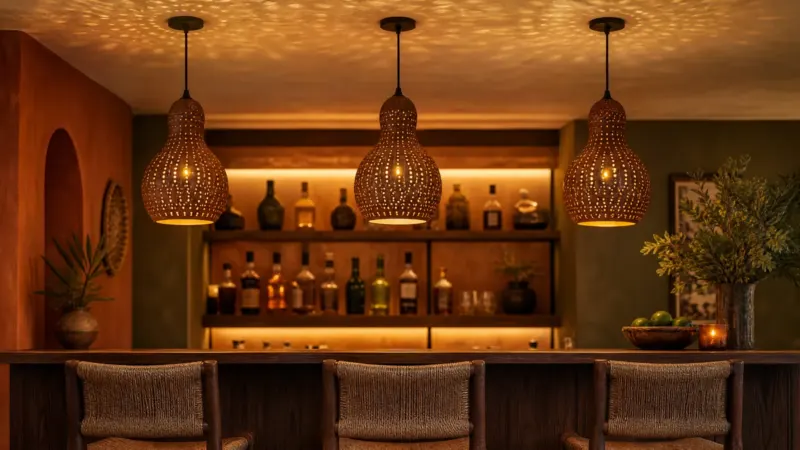
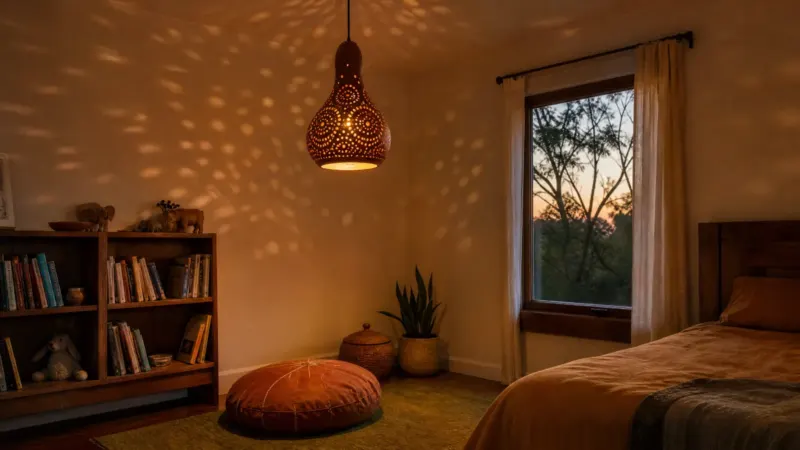
A gourd table lamp is a dried plant shell with holes cut in it, standing on a piece of turned wood, with a bulb inside. Described that way it sounds like nothing. In a dark room it covers the ceiling and the surrounding walls with a few hundred points of warm light, and people who have never seen one tend to stand under it for a while. This is a guide to owning one: what it does, what it does not do, and what to expect over the years.
I make these, so read accordingly. I have tried to be more useful than promotional, which mostly means telling you the parts that go wrong.
What a gourd table lamp is made of
A bottle gourd, a calabash grown as a crop rather than foraged, is harvested and then dried for somewhere between four and nine months. During drying it loses most of its water, the outer skin goes mouldy and flakes off, and what remains is a hard woody shell a few millimetres thick. It is closer to a coconut than to a vegetable at that point.
That shell gets cleaned, scraped and sanded, then carved: hundreds to several thousand small holes drilled in a pattern, sometimes with coloured glass beads set into the larger ones. It is finished with oil or a thin varnish and mounted on a turned wooden base carrying a standard socket. The full sequence, with the failure points, is in the piece on how a gourd becomes a lamp.
The consequence of all that: the material is organic, light, and slightly different every time. A shell that dried a little oval stays oval. That is the trade you are making.
What the light actually looks like
Points, not pools. Each hole projects a small bright spot, and the spots fan outward and land on the ceiling, the walls, and anything within a couple of metres. The pattern is sharpest close to the lamp and spreads as it travels. Walk past it and the whole field shifts, because you are moving relative to a point source.
Three things change the result significantly:
- Bulb type. A clear filament LED is a near point source and throws crisp dots. A frosted bulb blurs them into a glow and wastes most of the carving. This is the single biggest variable and it costs a few pounds to get right.
- Surrounding surfaces. Smooth pale walls hold the pattern. Dark or heavily textured walls absorb it. In a room with charcoal walls the lamp becomes a glowing object, which some people prefer.
- Distance to the nearest wall. Under about 50cm the pattern is small and dense. Push it out to a metre and it opens up considerably. Move the lamp around before you decide where it lives.
What it cannot do
Stated plainly so nobody is surprised.
You cannot read by it. Most of the light output is blocked by the shell and what escapes is directional and patterned. It belongs in a room that already has a working light source, switched on after the main light goes off.
It does not belong in a bathroom, a laundry, or anywhere with steam. The shell is organic and will take up moisture, which over time softens it and can encourage mould in the interior. This is not a warranty position, it is a property of dried plant material.
It is not an outdoor lamp. Covered porch in a dry climate, at a stretch, brought in when the weather turns. Anywhere rain reaches, no.
And it will not match the photograph exactly. Every product page here says so. If you need an item identical to a picture, buy a manufactured lamp. That is a legitimate preference and this is the wrong product for it.
Sizes and where each one goes
| Shell size | Overall height | Suits | Pattern spread |
|---|---|---|---|
| Small | 25–32cm | Bedside, bookshelf, alcove | Tight and dense, close in |
| Medium | 33–42cm | Console, side table, sideboard | Balanced; the general-purpose size |
| Large | 43–55cm | Corner table, wide console, hallway | Wide, reaches the ceiling well |
The usual proportion rule applies: the lamp wants to be about a third to a half the width of the surface it stands on. The sizing guide goes into the measurements properly if you are between two options.
One practical note: because the shell is hollow and light, a large gourd lamp weighs less than a small ceramic one. That is good for shelves and bad for stability on a surface that gets bumped. Felt under the base helps more than you would think.
Bulbs, heat and lifespan
Warm white LED, 2700K, 4 to 6 watts, clear glass, E26 or E27 depending on where you are. That is the whole specification.
The reason to stay low-wattage is heat. A hot incandescent bulb inside a dried shell drives out what little moisture is left in the material and, over a few years, can open hairline cracks along the grain. An LED at 5W runs barely warm and the shell stays stable. Get this right and the lamp outlives you; get it wrong and you will see cracking in five to ten years.
Colour temperature matters too. Anything above about 3000K makes the shell look grey and dead. The warm end flatters the material.
Living with one: cleaning and the humidity question
Cleaning is a dry paintbrush, twice a year, worked over the carved surface to lift dust out of the holes, with a vacuum held a few centimetres away to catch it. No water. No polish. No furniture spray. The care guide has the full method and the list of things that damage the finish.
On humidity: normal domestic swings are fine. The shell has already survived months of open-air drying. What it does not tolerate is sustained damp: an unheated room in a wet climate, a basement, a bathroom. If your home runs consistently above about 70% relative humidity, a dehumidifier in that room solves it and is worth doing for the rest of your furniture anyway.
If a bead ever comes loose, keep it. A dot of clear adhesive puts it back and the repair is invisible.
How it compares to the obvious alternatives
Against a glass mosaic lamp: lighter by a factor of three or four, far less likely to break in transit or when knocked, and a sharper, whiter pattern. It loses on colour, because glass gives deep cobalt and emerald that a shell cannot. The full comparison covers this properly.
Against a fabric-shade lamp: no contest on atmosphere, no contest the other way on usable light. They do different jobs and a room can happily hold both.
Against a carved wooden lamp: similar effect, considerably heavier, usually more expensive because the carving is done in solid material rather than a thin shell.
What arrives, and the first ten minutes
The box is bigger and lighter than you expect. Inside, the lamp usually arrives assembled, with the shell already mounted on the base and the cable coiled, wrapped in paper and suspended in crushable material so nothing presses on the carving.
Take it out by the base, not by the shell. The shell is strong across its curve and weaker at the rim, and lifting a lamp by its shade is how rims crack.
Check three things before you plug anything in. That the socket is firm in the base and does not rotate when you hold it. That the cable has a strain relief where it enters the wood and no conductor is visible. And that the switch clicks properly. If any of those are wrong, photograph it and contact the seller before use rather than after.
Then fit the right bulb, which is almost certainly not the one in the box. Clear, 2700K, 4 to 6 watts. Turn the room lights off, put the lamp roughly where you think it lives, and look at where the pattern actually lands. Move it 30cm and look again. This takes five minutes and it decides whether the lamp is worth having.
Positions that work, and one that does not
The best positions share a property: a plain pale surface within about a metre for the pattern to land on.
A hallway console against a bare wall is the strongest single position, because the pattern has somewhere to go and the lamp is seen at night when it is doing its job. A bedside table works well, with the caveat that it is ambient light and you will want something else to read by. A bookshelf or an alcove concentrates the pattern on the enclosing surfaces and is quietly the most dramatic option. A sideboard in a dining room reads well against a lit table.
The position that disappoints is the middle of a large open-plan room, on a low coffee table, with nothing within two metres. The pattern spreads until it is too faint to register and the lamp becomes a small glowing object with no effect on the room. If that is your only option, hang one instead. The hanging lamp guide covers the drop heights.
Worth knowing: the effect is strongest in a room you can make genuinely dark. In a city flat with streetlight coming through thin curtains, the pattern competes and loses. Lined curtains do more for a carved lamp than a bigger lamp does.
One last practical point: if the lamp is going somewhere with underfloor heating or directly above a radiator, move it. Sustained dry heat from below is the one indoor condition that will work against a dried shell over the years, and a shelf 30cm to the left solves it entirely.
Common questions about gourd table lamps
Is a gourd table lamp fragile?
Less than it looks. The dried shell is hard and only a few millimetres thick, so it is light and it usually survives a knock that would destroy a glass lamp. It can dent or crack if dropped onto a hard floor from height, and the wooden base is the heaviest part, so it tends to land base-down.
What bulb should I use in a gourd lamp?
A clear warm-white LED at 2700K, 4 to 6 watts. Clear glass rather than frosted, because a point source throws a sharp pattern and a diffused bulb blurs it. Avoid incandescent bulbs above about 25W, since the heat dries the shell and can open hairline cracks over several years.
How long does a gourd lamp last?
Indefinitely, in normal indoor conditions with a low-wattage LED. The shell has already been dried and stabilised over months. The two things that shorten its life are sustained damp and heat from a high-wattage bulb, and both are entirely under your control.
Can a gourd lamp go in a bathroom or outdoors?
No to bathrooms and to anywhere with steam or rain. The shell is organic and absorbs moisture, which softens the material over time. A covered porch in a dry climate is the outer limit, and the lamp should come indoors when the weather changes.
Will my lamp look exactly like the photo?
No, and that is stated on every product page here. Each gourd dries to its own shape, the wood grain on the base differs, and the carving lines drift by a millimetre or two. The pattern and the size will match; the individual piece will be its own.
The full range of gourd table lamps is made to order at a flat $279 with worldwide shipping included, and there are hanging versions if the table format is not what your room needs.