Turkish Chandeliers and Hanging Lamps: A Complete Buyer’s Guide

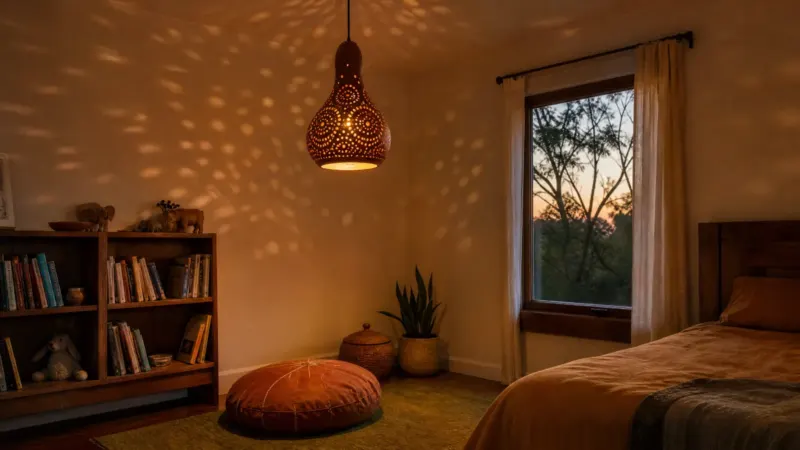
A Turkish chandelier does something an ordinary pendant does not. Turn it on in a dark room and the light doesn’t stop at the shade. It goes straight through it. Every drilled hole and every bead throws a small dot of color onto the wall behind, and if your ceiling is low enough you get the pattern overhead too. That effect is the entire reason these lamps exist, and it’s also why buying one takes a little more thought than picking a shade off a shelf.
Here’s what customers actually ask us before they order: how our carved gourd lamps differ from the glass mosaic ones they’ve seen, what size suits their room, how high to hang it, which bulb to put in it, and whether they need an electrician. All of that is below, with real numbers.
What makes a Turkish chandelier different
A normal pendant light works by blocking light. The shade sends most of the output downward, so you get a bright pool on the table and a fairly dark ceiling. Turkish hanging lamps do the opposite. The shell is pierced, so light escapes sideways, upward, and in every direction the maker drilled. The wall becomes part of the fixture.
Be clear with yourself about what you’re buying. This is atmosphere lighting. A single carved gourd will not give you enough downward light to read a recipe or do homework under, and anyone who tells you otherwise is selling. Plan on keeping a lamp, a downlight, or under-cabinet strips in the same room and using the chandelier as the evening light. Once you accept that, it’s a wonderful thing to own. Turn everything else off and the room changes completely.
The second thing that sets these apart is that the pattern is fixed in the object. A projector cycles through images. A carved gourd throws the same constellation on your wall every night, and it shifts as you walk around it because the shadows move with your eye.
Gourd chandeliers vs glass mosaic chandeliers
Most people searching for a Turkish lamp have a picture in their head of a brass frame packed with hand-cut stained glass and small mirrored tiles, grouted in place. That’s the classic mosaic chandelier, and it’s a genuinely beautiful object. It is not what we make, and you should know that before you order.
Ours are carved gourd. A calabash gourd is grown, dried for months until the shell is hard and hollow, then cut, cleaned, and drilled by hand. Glass and acrylic beads are set into the drilled holes. The base is wood. If you want the full background on the mosaic tradition and where gourd lamps sit alongside it, we wrote about that in what a Turkish mosaic lamp actually is, and there is a direct comparison in gourd lamps vs Turkish mosaic lamps.
| Carved gourd | Glass mosaic | |
|---|---|---|
| Shell material | Dried calabash, wooden base | Metal frame, cut glass and tile |
| Light quality | Warm amber through the shell, sharp dots of color from the beads | Saturated stained-glass color across the whole surface |
| Pattern on the wall | Crisp, because the holes are small and clean | Softer, broader blocks of color |
| Weight | Light. Our desktop version is about 0.9 kg complete | Considerably heavier |
| Consistency | Every gourd is grown, so no two are identical | Repeatable from a mold or frame |
| Cleaning | Dry dusting only, no soaking | Tolerates a damp cloth on the glass |
My honest opinion after years of this: gourd gives you a better pattern on the wall, and mosaic gives you a better-looking object when it’s switched off. Pick based on which of those matters more in your room. If you’re weighing up the whole category, our broader Turkish lamps buyer’s guide goes wider than chandeliers alone.
What we make, and what it costs
There are 13 chandelier designs in the range: turquoise drops, starfish, rainbow, pineapple, lotus flower, flower with colorful beads, fish, dolphin, daisy, colorful drops, butterfly, and blue beads among them. There are 17 designs in the desktop range if you’d rather have a table lamp or want a matching pair on a sideboard. Everything is $279 with free worldwide shipping.
Each piece is made to order. Production takes 5 to 7 days, and shipping runs 2 weeks depending on where you are. If you’re buying for a specific date, count backward and give yourself a buffer.
Picking a size for the room
The old interior-design rule still works as a starting point. Add the length and width of your room in feet, and that number in inches is roughly the diameter of a chandelier that will look balanced. A 12 by 14 foot living room wants something around 26 inches across.
Gourd lamps are usually smaller than that, and this is where people get stuck. A single gourd shell is closer in scale to a large pendant than to a hotel-lobby fixture. Our desktop lamps measure 20 to 23 cm across and 25 to 35 cm tall, which gives you a feel for the material. Gourds are grown rather than manufactured, so exact dimensions vary from piece to piece. Message us before you order and we’ll measure the shells for the design you’re looking at.
If a single lamp reads as too small for the space, hang two or three of the same design at staggered heights instead of hunting for one giant fixture. Over a long dining table that looks intentional and gives you the pattern along the whole wall rather than one hot spot. Over a round table, one centered lamp is right. In a hallway, stairwell, or small bedroom, one is plenty.
How to hang Turkish lamps at the right height
This is the part people get wrong, and it’s the easiest thing to fix. Because the light comes out sideways, hanging one too high wastes the effect. Hang it too low over a table and you’ll have a bright object at eye level while you’re trying to talk to someone.
| Location | Height | Measured from |
|---|---|---|
| Over a dining table | 75-90 cm (30-35 in) | The tabletop to the bottom of the lamp |
| Over a kitchen island | 75-85 cm (30-33 in) | The counter surface |
| Beside a bed, in place of a nightstand lamp | 50-60 cm (20-24 in) | The top of the mattress |
| Hallway or entry, open floor | At least 210 cm (7 ft) clearance | The floor to the bottom of the lamp |
| Stairwell or over a landing | At least 210 cm (7 ft) clearance | The highest tread the lamp hangs over |
If your ceiling is higher than 244 cm (8 ft), add about 7.5 cm of drop for every extra 30 cm of ceiling height. In a stairwell, always measure from the step directly beneath the lamp, not from the floor at the bottom of the stairs. That single mistake accounts for most of the head-height complaints we hear about.
One more thing worth testing before you drill. Hold the lamp roughly where you plan to hang it and look at what’s behind it. The pattern needs a surface to land on. A gourd chandelier against a plain plaster wall is spectacular. The same lamp in the middle of a wide open-plan room with nothing within three meters of it is much less so.
Which bulb to use, and why it matters more than you’d think
The bulb decides how good your pattern looks. Two rules.
- Go clear, not frosted. A small, compact light source casts sharp shadows. A big frosted globe scatters light in every direction inside the shell and the pattern on your wall goes soft and muddy. Clear LED filament bulbs work well.
- Go warm and low. Aim for 2200K to 2700K and around 4 to 6 W of LED, which is the old 40 W ballpark. High output does not improve the effect. It flattens the contrast between the bright dots and the dark wall, and it puts heat into a dried organic shell and acrylic beads. LED runs cool, and that’s exactly why we recommend it.
A dimmer is a genuine upgrade if the fixture supports it, since the pattern gets stronger the lower you take the room lights around it. Our desktop lamps use a standard E27 screw socket with a CE certificate, work on both 110-120 V and 220-240 V, and come with a 2 m cable and an inline on/off switch. If you’re ordering a chandelier for a particular fitting, ask us to confirm the socket and cable length for that design before it goes into production.
Ceiling wiring and when to call an electrician
Weight is rarely the problem here. A gourd shell with its wooden base is light enough that a standard ceiling rose or hook will carry it without drama. Wiring is the real question.
If you already have a working pendant on that spot and you’re swapping fixtures, most people handle it themselves in ten minutes with the breaker off. Call a licensed electrician if any of the following is true: there’s no existing ceiling point where you want the lamp, you’d need to run cable through a stairwell or a vaulted ceiling, your home has old two-wire circuits with no earth, you rent and your lease requires it, or you simply aren’t sure. Electrical rules differ by country, and an unpermitted ceiling point can cause you trouble at resale.
Renters, take the easy route. A swag hook screwed into a joist plus a plug-in cord set lets you hang a turkish pendant light anywhere in the room and take it with you when you move. That’s also the simplest way to get a boho pendant light over a corner reading chair where no wiring exists.
Care and cleaning
Gourd is a natural material and it behaves like one. Treat it a bit like an instrument rather than like a glass shade.
- Dust every few weeks with a dry, soft brush. A clean makeup brush or a soft paintbrush gets into the carved holes better than a cloth, which snags on the bead edges.
- For marks on the outer shell, use a barely damp cloth and dry it right away. Never soak the gourd, never run it under a tap, and keep water away from the socket.
- Skip solvents, alcohol wipes, and anything abrasive. They can dull the shell finish and loosen the adhesive around the beads.
- Keep it out of bathrooms, steamy kitchens, covered porches, and direct sun. Repeated humidity swings are the main thing that shortens a gourd lamp’s life, and strong sunlight fades the beads over the years.
- Every so often, run a fingertip over the beads while the lamp is cool and off. If one feels loose, a dot of clear craft adhesive puts it back before it drops.
Frequently asked questions
How high should I hang a Turkish chandelier over a dining table?
Hang the bottom of the lamp 75 to 90 cm above the tabletop. That keeps it clear of sight lines across the table while staying low enough for the carved pattern to reach the walls. For ceilings above 244 cm, add roughly 7.5 cm of drop per extra 30 cm of height.
Do I need an electrician to install a Turkish pendant light?
Not if you’re replacing an existing pendant on a working ceiling point, which is a ten minute job with the breaker off. Hire a licensed electrician if you need a new ceiling point, cable run through a stairwell or vaulted ceiling, or your circuits are old and unearthed. Renters can use a swag hook and plug-in cord instead.
Can I put a gourd chandelier in a bathroom?
I’d rather you didn’t. Steam is the one condition that reliably damages a dried gourd shell. A powder room with good ventilation and no shower is a reasonable exception.
Will it work with my voltage?
Our desktop lamps are built for both 110-120 V and 220-240 V with a CE-certified E27 socket, so they run in North America, Europe, Australia, and most other places. You may need a plug adapter for the shape of your outlet.
Do the designs come in different colors?
The bead colors are part of each design. Turquoise drops reads cool and blue on the wall, rainbow scatters mixed colors, blue beads is the calmest of the group. The gourd shell itself always projects warm amber underneath whatever the beads are doing.
If you’ve got a spot in mind, measure the drop first and then go look at the 13 chandelier designs. All 13 are $279 with free worldwide shipping, made to order in 5 to 7 days. Send us a message with your ceiling height and the room it’s going in and we’ll tell you honestly which one suits it best.