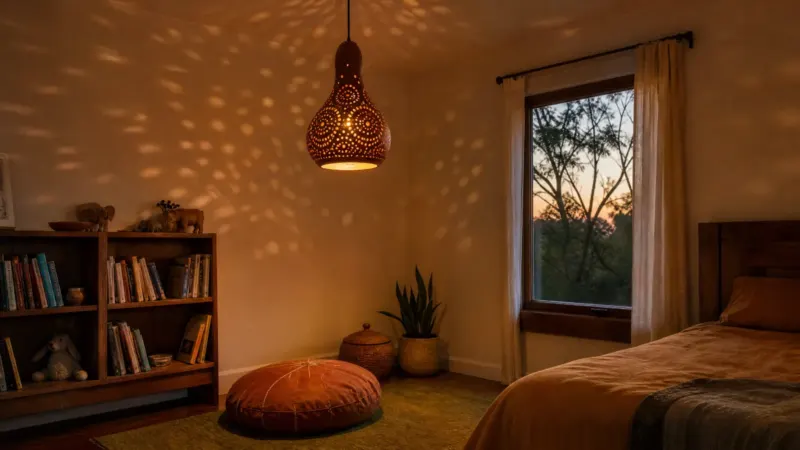
How a Gourd Becomes a Lamp: Inside Gourd Art

A gourd lamp starts in a field, and the field part takes longer than the workshop part. By the time a shell is hard enough to hold a carved pattern, it has spent a summer on a vine and several months hanging in a shed. The drilling and beading most people picture when they think about gourd art is the short stretch at the end of a slow process.
Here is what happens in between.
Gourd art starts with a crop, not a craft supply
The plant is Lagenaria siceraria, the bottle gourd or calabash. It is not the small warty ornamental squash sold in autumn displays. Those belong to the genus Cucurbita, and their walls stay thin. Lagenaria is a crop plant, grown for its fruit, and people have used the dried shells for water bottles, floats, birdhouses, and the bodies of stringed instruments in most warm parts of the world. When it dries, it stops behaving like a vegetable and starts behaving like a shell.
Shape gets decided in the field, before any maker touches it. A gourd left lying on the soil flattens on the side it rests on. One trained up a trellis hangs free and grows rounder, with a straighter neck. Growers who supply lamp makers usually hang them for that reason. The fruit is cut from the vine with a stub of stem attached, before the first hard frost. Pulling or twisting it off tears the neck open and lets rot in.
Drying is the part that takes months
This is the step no one can shorten. A freshly picked bottle gourd is mostly water. It has to lose that water slowly, in a dry place with air moving on all sides, usually hung or laid on an open rack so nothing sits flat against a surface.
The outside hardens within a week or two. The inside takes far longer. Extension guides put full curing anywhere from one to six months depending on the size of the fruit, and a large gourd meant for a lamp sits at the long end of that range. It gets lighter and lighter until it feels wrong in your hands, like a paper model of itself. The test most growers use is sound: shake it, and when the dried seeds rattle loose inside, it is ready.
While it dries, mold blooms across the skin in dark blotches. This alarms people the first time they see it. It is normal. The mold feeds on the moist outer skin, not on the shell underneath, and a gourd covered in it is usually a gourd that is drying properly. Some of it leaves permanent mottling on the shell, which certain makers keep on purpose because it reads as a natural marbling under stain.
Scrubbing and hollowing
A cured gourd gets soaked in water for a while, then scrubbed. Steel wool, a copper pad, or the dull edge of a knife takes off the dead skin and the mold with it. Underneath is a hard tan surface, a few millimeters thick, that files and sands roughly like a dense wood.
Then the maker cuts an opening, normally at the bottom where the base and the socket will sit, and pulls out the inside. Dried pulp comes away in fibrous sheets. Seeds pour out by the hundred. The interior wall gets scraped down with a hooked tool or a sanding drum so the lamp does not shed dust every time it is moved. This is dirty, unglamorous work, and it is where a bad gourd reveals itself: a soft patch, a hidden crack, a wall too thin on one side to survive drilling.
The pattern goes on before anything gets cut
You cannot lay a flat template on a sphere. Any grid drawn evenly on paper will stretch and crowd once it is wrapped around the belly of a gourd, and every gourd bulges differently. So the pattern is marked directly on the shell, usually in pencil, working out from a few reference lines around the widest point and down the vertical axis.
Makers who work in repeating motifs count out the divisions by hand and adjust as they go. The pattern has to close cleanly where it meets itself on the back. On a shell that is 2 centimeters wider on one side than the other, that means quietly fudging the spacing across several repeats so the eye never catches it.
Drilling and carving
The holes come next, and they are the whole design. A rotary tool with fine bits does most of it, from pinpricks up to openings wide enough to take a bead. Hand gouges cut the wider channels and any relief work where the surface is carved down rather than pierced.
Two things make this harder than it looks. The first is that dried gourd is brittle in the way a walnut shell is brittle. Drill two holes too close together and the bridge between them blows out, and there is no filling that back in. The second is dust. Gourd dust is fine, it hangs in the air, and it irritates lungs enough that a respirator is standard equipment. Most makers drill outward from the center of a motif so any error stays inside an area that can still be reworked. If you want the sequence laid out step by step, our guide on how to make a gourd lamp walks through it.
Setting the beads
Some of the drilled holes get a glass or acrylic bead pressed into them and fixed from the inside. The bead is doing real optical work. Light passing through an open hole lands on the wall as a warm dot the color of the bulb. Light passing through a colored bead is refracted and tinted, so it lands as a small saturated point of blue or amber or green.
Run both across the same shell and the projection gets two layers: a field of plain dots carrying the shape of the pattern, and a scatter of colored ones sitting inside it. That contrast is why bead placement is a design decision rather than decoration. Beads clustered at the crown of a gourd throw color straight up onto the ceiling. Beads set low around the belly push it out sideways across the walls.
Stain, wax, and wiring
The bare shell is pale tan. Most pieces get stained, and gourd takes stain unevenly, drinking more where the wall is porous and less where it is dense, which is part of why two lamps from the same batch never match in tone. After that comes wax or oil, buffed back to a low sheen. Some makers coat the interior in a pale color to bounce more light out through the holes.
Then it becomes an actual lamp. The shell is seated on a turned wooden base, an E27 socket goes in, and the cord runs out through the base. Ours carry a CE certificate, run on either 110-120V or 220-240V, and come with a 2 meter cable and an inline switch. A table piece measures 20 to 23 centimeters across and 25 to 35 centimeters tall, and weighs about 0.9 kilograms.
Bulb choice matters more here than with most lighting. A small, bright, point-like source casts crisp shadows, so a clear filament-style LED gives sharply defined dots on the wall. A large frosted bulb spreads the source out and the projection goes soft and blurry. Low wattage LED also keeps the heat down inside what is, after all, a dried plant.
Why no two gourd lamps are alike
Every gourd grows its own shape. Wall thickness, curve, the angle of the neck, the width at the shoulder, all of it varies fruit to fruit, and none of it can be specified in advance. A pattern drawn for a tall narrow shell has to be redrawn for a squat one. Even working from the same design, the maker is adjusting hole spacing to the object in front of them, which means a design can be repeated in spirit but never reproduced exactly.
This is the honest difference between handmade home decor and a molded product. The variation is not a tolerance being met. It is the material setting the terms. Across our 30 designs, split between 17 table lamps and 13 chandeliers, the photographs show the design, and the piece that ships is that design carried out on a shell that grew its own way.
One clarification, since people ask. A gourd lamp is a different craft from the glass mosaic lamps also sold as Turkish home decor, where cut glass and beads are laid onto a glass globe. If you have been comparing the two while working out how Turkish lamps are made, we wrote a separate piece on what a Turkish mosaic lamp is, and a direct comparison in gourd lamps vs Turkish mosaic lamps. Both throw patterned light. The materials and the methods have almost nothing in common.
Living with a dried organic object
A gourd shell stays sensitive to moisture for the rest of its life, which shapes how you look after it.
- Dust it dry. A soft brush or a dry cloth. Water sitting in a carved hole can swell the shell and lift the finish.
- Keep it out of damp rooms. Bathrooms and unheated porches swing between wet and dry too sharply, and that cycling is what cracks a shell.
- Keep it out of direct sun. Sunlight fades stain over months, and fades it unevenly on a curved surface.
- Use LED. Cooler running, and the light quality suits the pattern better.
- Hang chandeliers from the fixture, not the cord. The shell is light, but the cable is not a structural part.
Treated reasonably, there is nothing fragile about it. Dried gourd containers survive for decades in ordinary household use.
What made to order actually means
Nothing sits in a warehouse waiting. When an order comes in, a cured shell is selected, hollowed, marked, drilled, beaded, finished, and wired for that order. Production runs 5 to 7 days, then shipping takes 2 weeks, and shipping is free worldwide. Every design is $279.
The wait is mostly the drying, and that already happened. Those months sat in the shed long before your order existed, which is the quiet economics of artisan home decor: the slowest step in making a handmade lamp is the one nobody bills for.
Frequently asked questions
How long does a gourd have to dry before it can be carved?
Curing takes one to six months depending on the size of the fruit, and a large lamp gourd sits at the long end of that range. The outer shell hardens in a week or two, but the interior needs far longer. Makers test by shaking it: when the dried seeds rattle loose, it is ready.
Is the mold that grows on a drying gourd a problem?
No. The mold feeds on the damp outer skin while the shell cures underneath, and heavy blotching usually means the gourd is drying properly. After curing it is soaked and scrubbed off with steel wool. Some mottling stays in the shell, and certain makers keep it as natural marbling under stain.
Why can’t two gourd lamps be identical?
Every gourd grows a different width, curve, and wall thickness, and the pattern is marked directly on that shell rather than printed from a flat template. Spacing gets adjusted by hand to fit the object in front of the maker. The design repeats across pieces. The exact hole layout and stain tone never do.
What bulb should I use in a gourd lamp?
A low wattage LED with a clear, filament-style envelope. A small bright source casts sharp shadows, so the carved holes project as crisp points of light on the wall. Frosted bulbs blur the pattern. LED also keeps heat down inside a dried plant shell. The socket is E27, rated 110-120V or 220-240V.
Why does a made-to-order lamp take several weeks?
Production runs 5 to 7 days, then transit takes 2 weeks, with free worldwide shipping. The drying months happened long before your order existed. What you are waiting on is the selecting, hollowing, marking, drilling, bead setting, finishing, and wiring done for one specific shell.
If you want to see how the patterns differ across shells, our table lamp designs are the easiest place to start, and the chandeliers show what the same technique does when the light is thrown across a whole ceiling.