Gourd Lamps vs Turkish Mosaic Lamps: What’s the Difference?

A gourd lamp and a Turkish mosaic lamp turn up in the same search results and get described with the same words. They are not the same object.
Two lamps show up in the same search results. One is a glass globe packed with cut colored tiles, grouted like a mosaic floor. The other is a carved brown shell on a wooden base with holes drilled through it. Both get sold as Turkish lamps, both photograph warm and golden, and both are described with the same handful of words.
They are not the same object. They are made from different materials, by different methods, and they do genuinely different things to a room. People order one expecting the other more often than you’d think, and the disappointment is avoidable.
I make the carved gourd kind, so factor that in. I’ll still tell you plainly where the mosaic lamp is the better buy.
The short version
A Turkish mosaic lamp is a glass object. Light travels through colored glass, so the lamp itself glows in red, blue, green and amber. You look at the lamp.
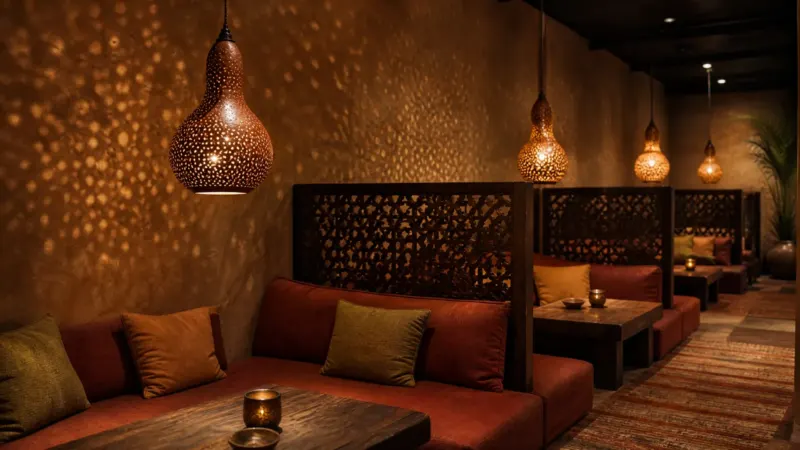
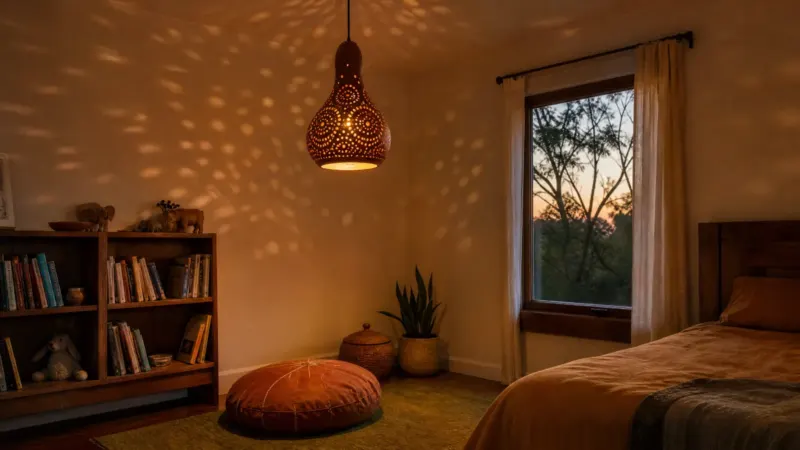
A gourd lamp is a carved shell. Light escapes only through drilled holes, so the shell stays dark while the pattern is thrown onto your walls and ceiling. You look at the room.
That single difference drives everything else. If you remember nothing else from this page, remember that one.
What a Turkish mosaic lamp actually is
The craft is glasswork. A maker cuts small pieces of colored glass by hand, arranges them onto a clear glass globe or into a metal frame, packs glass beads into the gaps, and grouts the whole surface so the pieces lock in place. It’s tilework, done on a curved surface, at small scale.
Switch one on in a dark room and the effect is immediate. The globe becomes a lit jewel. Ruby and cobalt sit next to each other, the beads catch and throw small highlights, and the color is in the light coming out. What it does to the surrounding wall is fairly modest. Most of the show is contained in the object.
You’ll find them as single table globes, as hanging clusters of five or seven on a brass ceiling plate, and as floor lamps with stacked globes of decreasing size. The category is enormous, and quality varies wildly. We’ve written more on the technique in what is a Turkish mosaic lamp.
What a gourd lamp actually is
Different material entirely. The plant is Lagenaria siceraria, the bottle gourd or calabash, grown as a crop. After harvest it hangs in a dry shed for months, sometimes as long as six, until the water has left it and the shell has hardened. What you’re left with weighs almost nothing and files roughly like a dense wood.
The shell gets scrubbed clean, cut open, and hollowed out. A pattern is marked directly onto it in pencil, because no flat template survives being wrapped around a curved gourd. Then the holes are drilled by hand, from pinpricks up to openings wide enough to take a bead. Glass and acrylic beads are pressed into some of those holes and fixed from the inside. The shell is stained, waxed, seated on a wooden base and wired.
Turn it on and the shell barely lights up at all. Each drilled hole works like a small projector, sending a narrow beam outward. On a wall two meters away you get a field of hard-edged dots, arcs and rings spreading across the plaster and up over the ceiling. The beads bend and tint some of those beams, so scattered through the pattern are points of turquoise, amber and deep blue. If you want the process step by step, that’s covered here.
Side by side
| Turkish mosaic lamp | Carved gourd lamp | |
|---|---|---|
| Material | Cut colored glass and beads, grouted onto glass or metal | Dried calabash shell, wooden base, glass and acrylic beads |
| Craft | Glasswork and grouting | Drying, carving and drilling |
| Where the light goes | Through the glass, so the lamp glows in color | Out through holes, so the pattern lands on walls and ceiling |
| Effect at 2 meters | Modest. The lamp is the focus | Strong. The room is the focus |
| Switched off | Handsome. Colored glass looks good in daylight | Quiet. A brown carved shell, more sculptural than decorative |
| Weight | Substantial. Glass and grout add up | Light. Our table lamps run about 0.9 kg complete |
| Two units side by side | Can match closely | Never identical. Every gourd grew its own shape |
| Cleaning | Dry cloth on the glass. Grout chips if knocked | Dry brush into the holes. Never soak |
| Typical price | $40 for small imports up to several hundred for hand-cut work | $279 flat across our 30 designs, shipping included |
The test that settles it
Here’s how to tell which one you want, and it takes ten seconds of honest thinking.
Picture the room at night with the overhead light off. Now ask yourself which mental image you were reaching for when you started shopping. Was it a beautiful glowing object sitting on a side table, the thing your eye goes to when you walk in? Or was it a dark room with patterns crawling across the ceiling above your bed?
The first is a mosaic lamp. The second is a gourd lamp. There’s no wrong answer, and plenty of houses want one of each in different rooms.
Where people go wrong is buying a gourd lamp because they liked a photo of the object, then finding it unremarkable in daylight. It is unremarkable in daylight. It’s a brown shell. Everything it has to offer arrives after dark.
What each one is bad at
Fair is fair, so here are the limits on both sides.
Mosaic lamps are heavy for their size, which matters if you’re hanging a cluster from a plasterboard ceiling. The grout chips if the piece gets knocked, and a chipped globe is difficult to repair invisibly. And the market is flooded with cheap versions using printed film or molded plastic panels instead of cut glass. Look at the edges of the pieces. Hand-cut glass is slightly irregular; printed panels are perfectly uniform and the “grout” is a molded ridge.
Gourd lamps can’t light a room. Not even close. You cannot read by one, and anyone who suggests otherwise is overselling. They need a wall or ceiling within a couple of meters for the pattern to land on, so a lamp marooned in the middle of a wide open-plan space wastes most of what it does. Dried gourd doesn’t like steam, so bathrooms are out. And because each shell grows its own shape, the piece that arrives won’t match the product photo exactly. The design will. The specific shell won’t.
Neither one is “the real Turkish lamp”
Occasionally someone asks which is authentic. Both are. They’re separate living crafts that happen to come from the same part of the world, and neither is a knockoff of the other. Mosaic glasswork is more widely exported and so more familiar. Gourd carving is smaller and less commercialized. That’s a difference in scale, not in legitimacy.
The related muddle is that a lot of mosaic glass gets sold as Moroccan and a lot of Moroccan pierced metal gets sold as Turkish. Sellers aren’t necessarily lying; the search terms have blurred together over the years. Judge the piece by its material and construction, not by the adjective in the listing title. Our Turkish lamps buyer’s guide goes further into telling genuine work from souvenir-shop output.
Get the bulb right or none of this happens
This applies to gourd lamps especially, and it’s the mistake I see most often.
- Clear, not frosted. A small compact filament casts hard shadows, which is what gives you sharp dots on the wall. A big frosted globe scatters light inside the shell and the pattern goes soft and muddy.
- Warm, 2200K to 2700K. Anything cooler drains the color out of the beads and turns the wooden base gray.
- Low output. A 2 to 4 watt LED, somewhere around 150 to 250 lumens. Fitting a bright bulb feels like the obvious upgrade and it ruins the effect: the holes stop reading as individual points and the contrast between the dots and the dark wall collapses. Brighter is worse here.
Our lamps use a standard E27 screw socket with a CE certificate, run on 110-120V and 220-240V, and ship with a 2 meter cable and an inline on/off switch. The switch is on/off only, so if you want to dim, use a plug-in dimmer or a dimmable smart bulb.
Living with either one
Mosaic glass tolerates a dry cloth and the occasional damp wipe on the glass surface. Keep it away from anywhere it might get knocked, since the grout is the weak point.
Gourd wants a little more thought, because it’s still a plant. Dust it with a dry soft brush rather than a cloth, working into and around the holes. An old makeup brush is ideal. Skip water, alcohol and solvents entirely. Keep it out of bathrooms and unheated porches, since repeated wet-dry cycling is the main thing that cracks a shell over time, and out of direct sun, which fades the stain unevenly on a curved surface. Once a year, run a fingertip over the beads while the lamp is cool; if one has worked loose, a dot of clear craft adhesive puts it back permanently.
Treated sensibly, neither is fragile. Dried gourd vessels survive decades of ordinary household use.
What we make
Thirty designs, split between 17 table lamps and 13 chandeliers. Every one is $279 with free worldwide shipping. Table lamps measure 20 to 23 cm across and 25 to 35 cm tall.
Each piece is made to order: 5 to 7 days in the workshop, then 2 weeks in transit. The drying months already happened long before your order existed, which is the quiet part of the economics. The slowest step in making one of these is the step nobody bills for.
If you’ve decided you want the pattern rather than the glow, send us a photo of the wall you’re aiming at and we’ll tell you honestly which design will fill it best. If you’ve decided you want the glow, buy the mosaic lamp. That’s the right call and I’d rather you were happy with it.
Frequently asked questions
Is a gourd lamp a real Turkish lamp?
Yes. Gourd carving and glass mosaic work are two separate living crafts from the same part of the world, and neither is a copy of the other. Mosaic glass is more widely exported, so it’s the one most people picture. That’s a difference in commercial scale rather than authenticity.
Which one throws patterns on the wall?
The gourd lamp. Its shell is opaque, so light escapes only through hand-drilled holes and lands on surrounding surfaces as sharp dots and arcs. A mosaic lamp passes light through colored glass instead, so the glow is contained in the lamp itself and the walls stay mostly dark.
Can I read by a gourd lamp?
No. It’s atmosphere lighting and produces very little downward output. Keep a separate reading lamp in the same room and use the gourd lamp in the evening once the other lights are down. That’s when it does what you bought it for.
What bulb should I use?
A clear LED filament bulb, 2 to 4 watts, at 2200K to 2700K, in a standard E27 socket. Clear glass keeps the projected dots sharp while frosted bulbs blur them. Low output matters more than anything else, because a bright bulb washes the pattern off the wall entirely.
Are gourd lamps fragile?
Not especially. Dried gourd vessels last decades in ordinary household use. Keep them out of bathrooms and away from steam, since repeated wet-dry cycling is what cracks a shell, dust them with a dry brush rather than a damp cloth, and avoid long spells in direct sunlight.