Boho Lamps: A Field Guide to the Real Thing

Boho lamp is one of the most heavily used tags in home lighting, and one of the least policed. It gets applied to hand-woven rattan from a workshop in Java and to a spray-painted plastic shade from a container ship, and the listing text is often identical. If you are trying to buy the first and keep getting the second, this is a field guide.
I will be upfront: we make carved gourd lamps, which is one family within this style. I have tried to write the rest of it straight, including the parts where another material is the better answer.
What boho actually means in lighting
Boho is the contemporary, softened descendant of bohemian style. Where bohemian was maximalist and accumulated, boho as it is used today is calmer, lighter in palette, and much more photogenic. It kept three things from the original and dropped the rest.
What it kept: natural materials, visible handwork, and warm low light. What it dropped: the density, the clashing colour, and most of the specific cultural origin.
That last point is why the label is so slippery. Bohemian lighting pointed at somewhere – Morocco, Turkey, Rajasthan. Boho lighting often points nowhere in particular, which makes it much easier to manufacture generically.
The materials that genuinely belong
Rattan and cane
The default boho material. Rattan is a climbing palm, cut into lengths and woven over a frame. It is light, strong, and the weave produces a soft dappled shadow that is the visual signature of the whole style. Good rattan has slight colour variation along each strand and small irregularities in the weave tension.
Seagrass, jute and abaca
Coarser than rattan, with a more rustic texture and a warmer natural colour. Seagrass in particular gives a chunkier weave that reads well on larger shades where fine rattan would look busy.
Bamboo
Straighter and more structural than rattan, so it suits slatted and ribbed shade designs rather than tight weaves. Produces striped rather than dappled light.
Carved wood and dried gourd
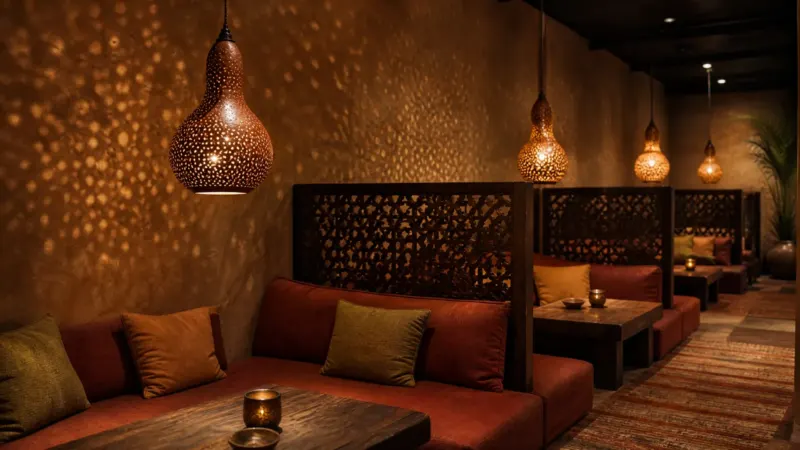
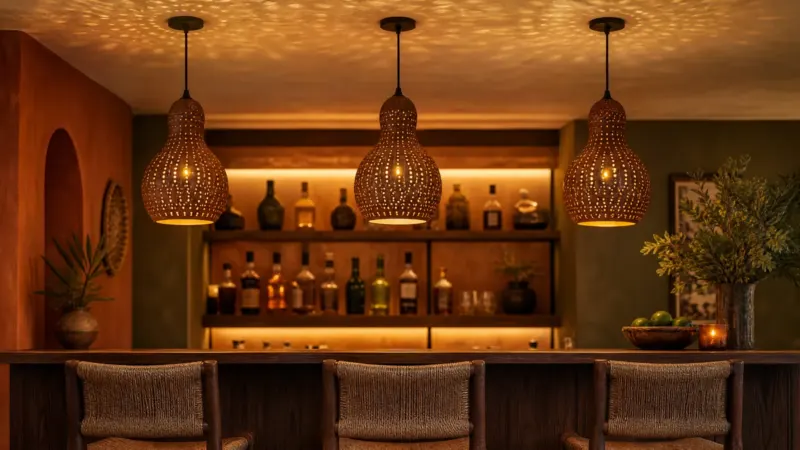
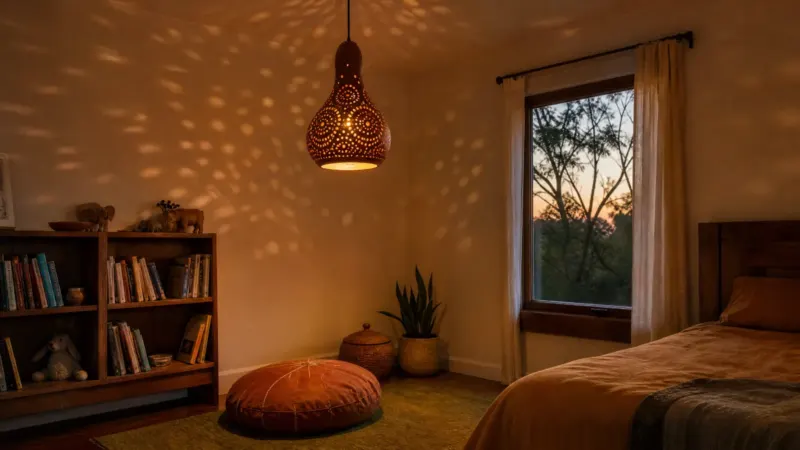
The pierced-shell family. A solid natural wall with a pattern cut through it, giving amber light and a defined projected pattern rather than a soft dapple. Heavier visual presence, lighter physical weight.
Ceramic and terracotta
Usually the base rather than the shade. Unglazed or matt-glazed earth tones. Adds weight and grounds a lamp that would otherwise feel flimsy.
Textile, macrame and raffia
The softest option and the one most often faked. Real macrame is knotted cotton with visible knot structure. The mass-market version is printed fabric with a fringe.

Comparing the families
| Material | Light quality | Usable brightness | Typical price | Durability |
|---|---|---|---|---|
| Rattan / cane | Soft dapple | Moderate | $60-220 | Good, dislikes damp |
| Seagrass / jute | Coarse dapple | Moderate | $50-180 | Good, sheds slightly |
| Bamboo | Striped | Moderate | $40-160 | Very good |
| Carved gourd / wood | Defined amber pattern | Low | $150-400 | Good, dislikes damp |
| Ceramic base | Depends on shade | n/a | $50-250 | Excellent, chips |
| Macrame / textile | Diffuse, little pattern | Good | $30-140 | Fair, collects dust |
Five ways to spot a mass-produced boho lamp
- Perfect regularity. Hand-weaving varies in tension. If every gap in the weave is identical, a machine made it.
- Printed texture. Look closely at the listing photo for a repeating pattern in what should be a woven surface. Printed fabric made to look like rattan is common and obvious once you know to check.
- Visible glue. Hand-woven pieces are tucked and tied. Glue beads at the rim are a factory tell.
- Identical photography across sellers. Reverse image search the main photo. If it appears on nine shops, none of them made it.
- No named material. Rattan-effect, natural-look, wood-finish. Each of those words is doing the opposite of its job.
None of these checks means a factory lamp is a bad buy. A $45 rattan pendant from a big chain can look perfectly good for a few years. The point is to pay handmade prices only for handmade work, and to know which one you are looking at before you pay.
Getting the light right, which matters more than the lamp
This is the part people skip, and it undoes everything else. Boho lighting depends on colour temperature more than on the fixture.
Use warm white LED between 2200K and 2700K. At 2200K you get a candle-like amber that makes natural fibre glow. At 3000K you are already into neutral territory and the weave starts to look grey. At 4000K a $300 hand-woven shade looks like a waiting room.
Wattage: 4 to 8 watts is plenty for a table lamp, 6 to 10 for a floor lamp. These fixtures are not trying to be bright.
Dimmable is worth the small premium here specifically. The whole style lives at low output in the evening, and a lamp you can drop to 30 percent is doing something a fixed one cannot.
Clear filament bulbs and frosted bulbs behave differently too. In a carved or pierced shade, a clear bulb gives sharp, defined pattern on the wall because the light comes from a small point. A frosted bulb spreads the source and softens every edge. Woven shades are the opposite case: they already diffuse the light, so the choice of bulb matters less than the colour temperature.
Layering, and why one lamp never works
A single boho lamp in a room lit by a ceiling fixture will always look like an accessory rather than a scheme. The style assumes multiple low warm sources at different heights, and it falls apart without them.
The practical version: turn the ceiling light off. Put a floor lamp beside the seating, a table lamp on a side surface, and something low – a small lamp on a shelf, or a candle. Three sources at low output. That is the look, and it costs less than one expensive statement piece.
Mixing materials across those three is better than matching them. Rattan floor lamp, carved shell on the side table, ceramic base on the shelf. The mismatch is the style, not a compromise.
Where each material works best in a house
Living room. Rattan or seagrass floor lamp beside seating, something carved on a side table for pattern.
Bedroom. Low warm bedside lamps, ideally a matching pair for symmetry even though the rest of the style avoids matching. Carved shells work well here because you do not need brightness.
Dining. A woven pendant over the table, hung low – bottom of the shade about 75 to 85cm above the tabletop.
Hallway. The best place for the most dramatic pierced piece you own, because nobody sits there and pattern is all it needs to do.
Bathroom and kitchen. Be careful. Natural fibre and dried organic material both react badly to steam and grease. Ceramic and glass are the safe choices in these rooms.
Kitchens and bathrooms are the exceptions. Steam, grease and humidity are hard on every natural material in this category. Rattan goes soft and saggy, gourd can take on moisture, and woven fibres hold on to cooking smells. If you want the look in a kitchen, a ceramic or glazed shade over the table is the practical choice, and a carved or woven piece is better kept in the dining area a few metres away from the hob. For a carved shell on a living room or bedroom table, our gourd table lamps are the family we make.
Care
Woven shades collect dust in a way smooth shades do not, and they go visibly grey within a year if ignored. Vacuum with a soft brush attachment or dust with a clean dry paintbrush every couple of months. Keep water off natural fibre entirely – it stains, and on rattan it can loosen the weave.
Carved shells want the same treatment: dry brush into the pattern holes, no water, no spray cleaner. Keep everything in this category out of direct sunlight, which fades dye and makes natural fibre brittle over a few years.
Carved and gourd shades need less attention than woven ones, since dust sits on a smooth surface rather than in a weave. A soft paintbrush through the holes every month or two is enough. The one thing to avoid on every material in this guide is spray cleaner, which lifts finishes and leaves a residue that shows up the moment the lamp is lit.
Check the cable and plug once a year as well. Natural materials hide wear, and a frayed flex tucked behind a woven base is easy to miss until it becomes a problem.
What boho lamps will not do
They will not give you good task light. Every material in this category trades brightness for texture. If you read, sew or work in that spot, put a dedicated task lamp there and let the boho piece handle atmosphere.
They will not survive humid rooms. Rattan, jute, gourd and wood all reabsorb moisture.
They will not look right under a bright ceiling light. The style needs the main light off.
And the handmade ones will not match each other or their photos. If that bothers you, buy the machine-made version and spend the difference elsewhere – that is a legitimate choice, not a failure of taste.
They also will not look like the listing photo in every room. Styled photos are shot at dusk against warm plaster walls. Put the same lamp against a cool white wall under a bright ceiling light at noon and it looks like a basket. Judge a boho lamp in the evening, in the room it is for.
Frequently asked questions
What is a boho lamp?
A lamp made from natural material with visible handwork, giving warm low light with texture – usually rattan, seagrass, bamboo, carved wood or dried gourd, ceramic, or knotted textile.
What bulb should I use in a boho lamp?
Warm white LED between 2200K and 2700K, 4 to 8 watts for a table lamp. Colour temperature matters more to this style than the fixture itself – cool white ruins the look regardless of what the lamp cost.
How do I tell if a boho lamp is handmade?
Check for variation in weave tension and colour, look for tucked and tied edges rather than glue, and reverse image search the listing photo. Perfectly uniform weave and reused photography both mean factory production.
Are rattan lamp shades safe?
Yes with LED bulbs, which run cool. Avoid incandescent and halogen in any natural-fibre shade and stay within the stated wattage.
Can boho lamps go in a bathroom?
Natural fibre and carved organic shells should not. Humidity causes staining, warping and mould. Ceramic and glass are the safe options for humid rooms.
How many lamps do I need for a boho living room?
Three low warm sources at different heights, with the ceiling light off. Mixing materials across the three works better than matching them.
Do boho lamps give enough light to read by?
Generally no. Woven shades give moderate output and carved shells give very little. Use a separate task lamp where you actually read.
Can you use a boho lamp in a kitchen or bathroom?
Not a natural-material one. Humidity, steam and grease damage rattan, woven fibre and dried gourd. A glazed ceramic or glass shade gives a similar warm look and copes with a kitchen or bathroom far better.
Related reading
For the two format-specific guides, see boho table lamps and boho floor lamps. On the older maximalist version of the style, read bohemian lamps and where the style came from. For the carved-shell family in detail, how handmade gourd lamps are made covers the material, and telling real craft from a factory copy applies the verification checks more widely. For pricing across handmade lighting, see what you get at each price point.