Bohemian Lamps and Where the Style Actually Came From

Bohemian lamps get sold on a word rather than a definition. Search the term and you get macrame, rattan, Moroccan brass, stained glass, carved wood and a great deal of beige fabric, all under the same label. Some of it belongs to the style. Much of it is beige fabric with a tassel.
This is where the style actually came from, what separates a bohemian lamp from a lamp marketed as one, and how to buy without paying a premium for the word.
Where the bohemian style came from
The word bohemian in this sense has nothing to do with Bohemia. It came from nineteenth-century France, where bohemien was used for travelling Romani people and then borrowed for artists and writers living outside conventional society. Poor, mobile, and furnishing rooms with whatever they collected.
That origin matters because it explains the aesthetic logic. Bohemian interiors look accumulated rather than bought, because historically they were. Objects came from different places and different decades and were never meant to match. The style is the absence of a matching set.
It resurfaced in the 1960s and 70s with the counterculture, picking up Moroccan, Indian and Turkish influence from overland travel routes, and again in the 2010s in a softer, more photographable form usually called boho.
The version most people mean today comes from a later revival. In the 1960s and 1970s, travellers on the overland route through Turkey, Iran, Afghanistan and India came home with textiles, brass and lamps, and the look of a room furnished from those journeys became shorthand for a certain kind of free-spirited home. That is why bohemian interiors lean so heavily on objects from the eastern Mediterranean and South Asia rather than from Bohemia or Paris.
That history explains a practical point for buyers. The objects that define the look were bought one at a time, on different trips, from different makers. A room that recreates it convincingly usually does the same: pieces added over months or years, not a matched set ordered in an afternoon. If you are starting from scratch, buy one good lamp now and let the rest of the room catch up with it.
What makes a lamp bohemian
Four things, and a lamp needs at least three of them:
- Handmade or handmade-looking. Visible craft. Weave, carving, hammering, glasswork.
- Natural or traditional material. Rattan, jute, wood, dried gourd, brass, coloured glass, ceramic. Not chrome, not plastic.
- Warm, low, patterned light. The lamp should do something to the light rather than just emit it.
- Origin you can point at. Moroccan, Turkish, Indian, West African, Central Asian. Somewhere specific.
A lamp that has none of these and one tassel is not bohemian. It is a beige lamp with a tassel.
Notice what is missing from that list: price and origin. A bohemian lamp does not have to be expensive or imported. A secondhand brass lamp with a handmade shade from a local maker fits the style better than a new factory lamp with a boho label. What the style rewards is the sense that each object was chosen and has a story, which is also why it is so hard to buy in one shopping trip.
The main families
Moroccan pierced metal
Brass or tin, punched with a pattern, often with coloured glass inserts. Throws the most dramatic light pattern of anything in the category. Works as a pendant more than a table lamp.
Turkish mosaic glass
Hundreds of cut glass pieces set in plaster over a glass globe. Colour-saturated, heavy, and instantly recognisable. This is the one most people picture when they hear Turkish lamp.
Carved organic shells
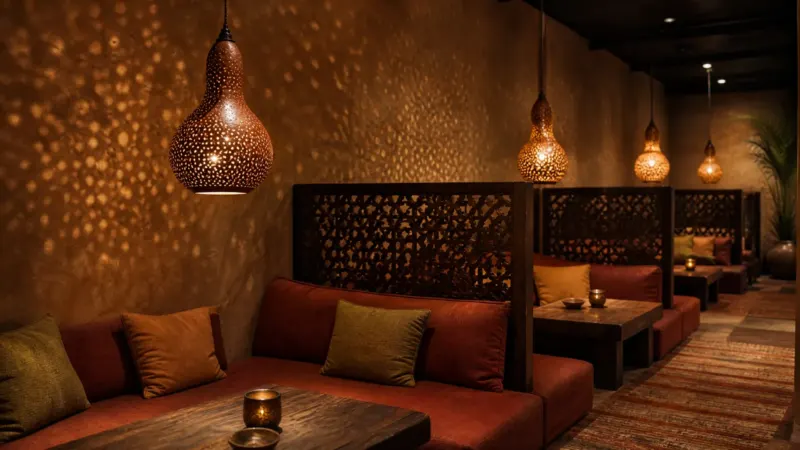
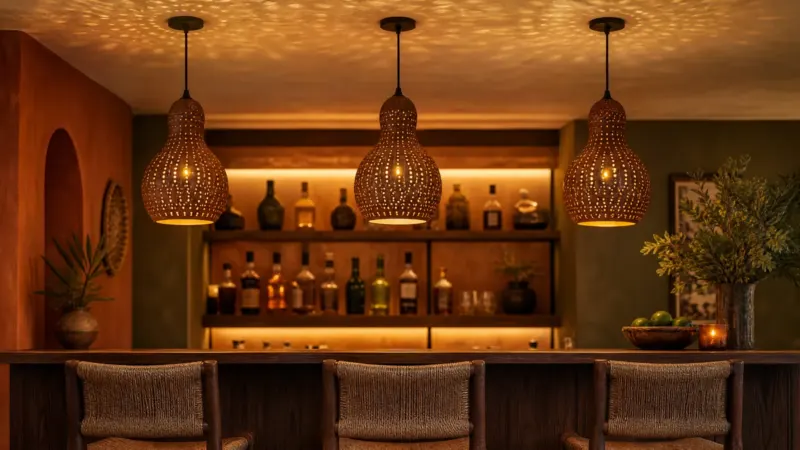
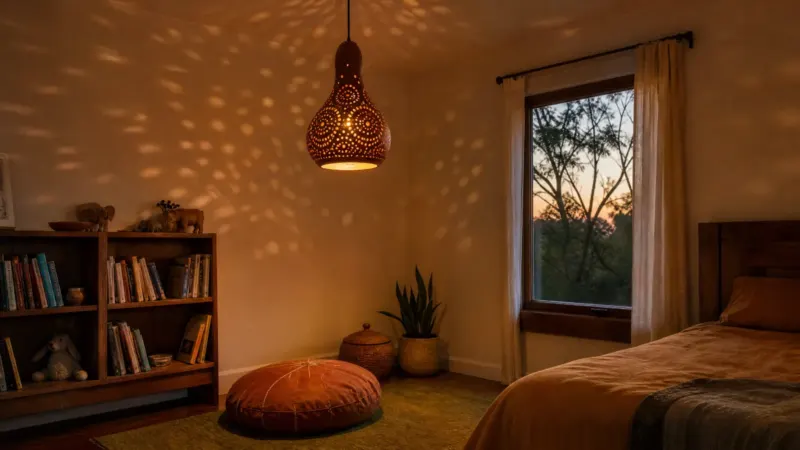
Dried gourd, carved wood, or coconut. Warm amber light through a pierced natural wall. Lighter and quieter than the mosaic version.
Woven fibre
Rattan, seagrass, bamboo, jute. The most contemporary end of the style and the easiest to place in a room that is not otherwise maximalist.
Textile and macrame
Fabric shades, knotted cotton, embroidery. Softest light, least pattern, most likely to be the mass-produced version of the style.
Two smaller families round out the category. Indian brass and textile lamps use embroidered or mirrored fabric shades, softer than metal and less dramatic in pattern. Paper and silk lanterns, often associated with the 1970s look, are the cheapest entry point and the least durable. Both sit comfortably next to the bigger families above, and mixing families is part of the style rather than a mistake.

Comparing the families
| Family | Light pattern | Weight | Typical price | Room fit |
|---|---|---|---|---|
| Moroccan pierced metal | Very strong | Medium | $80-350 | Hallway, dining |
| Turkish mosaic glass | Strong, coloured | Heavy | $60-400 | Corner, side table |
| Carved gourd or wood | Moderate, amber | Very light | $150-400 | Side table, shelf |
| Woven fibre | Soft dapple | Light | $60-250 | Anywhere |
| Textile / macrame | Minimal | Light | $30-150 | Bedroom |
The weight column matters more than it looks. Heavy mosaic and metal pieces need a solid surface and, as pendants, a ceiling fixing rated for them. Light carved gourd and paper pieces can go almost anywhere, including high shelves and plug-in swag hooks, which makes them the easier choice for renters.
The mistake that ruins the style
Buying one bohemian lamp and putting it in an otherwise matched room. The style does not work as an accent. A single Moroccan pendant over a grey sofa set reads as a souvenir, not as a look.
Bohemian lighting works when there are several warm low sources at different heights, from different origins, that do not match. Three mismatched lamps at 40 percent brightness beat one statement piece at full output. That is the actual principle, and it is cheaper than most people expect because none of the three has to be expensive.
The opposite mistake is less common but just as visible: every surface carrying a lamp from a different tradition, all at full brightness. Bohemian rooms look collected because the light is low. Five patterned lamps all switched on at 800 lumens each look like a shop window, not a home.
A simple fix for both mistakes is a separate switch or a smart plug for each lamp, so you can run two of them in the evening and leave the rest off until you want the full effect.
How to avoid paying for the word
The label carries a premium of roughly 30 to 50 percent on mass-market pieces. Things worth checking:
- Is there visible variation between listing photos of the same product? Handmade means variation. Identical photos across sellers means a warehouse.
- Is the material named, or only described? Rattan-effect, wood-look and metal-finish all mean the opposite of what they imply.
- Does the seller say where it was made? Vagueness here is usually deliberate.
- Is the pattern uniform hole to hole? Hand-punched and hand-carved work is never perfectly regular.
Check the materials line in the listing as well. “Rattan-look”, “wood-effect” and “metal finish” all mean the material is something else. That is fine at the right price. It is not fine at a handmade price. And if a lamp is described as bohemian with no mention of where or how it was made, assume it came off a production line until the seller tells you otherwise.
A fair price check for handmade work: find the same type of lamp from two or three makers who show their workshop. Their prices will cluster. A listing far below that cluster is almost always factory-made, and one far above it is usually charging for the brand or the photography.
Bulbs
Warm white LED, 2200K to 2700K. For coloured glass, go to the lower end – 2200K makes reds and ambers glow while 3000K flattens them. Dimmable is worth it in this style specifically, because the look depends on low output in the evening.
One practical warning: avoid high-wattage incandescent bulbs in any enclosed natural-material shade. LEDs run cool enough not to be a concern.
With several bohemian lamps in one room, keep the colour temperature the same across all of them. A 2200K bulb in a gourd lamp next to a 3000K bulb in a brass lantern makes one look orange and the other grey, and the eye picks up the mismatch immediately.
Two rooms where it works
A small city living room with a grey sofa and white walls. One kilim on the floor, a carved gourd lamp on the side table, and a pierced brass pendant over the reading chair on a separate switch. The ceiling light stays off in the evening. Three sources, two traditions, one palette of warm amber, and the room reads as bohemian without a single cushion changing.
A bedroom with limited surfaces. A pair of small matching pendants hung low either side of the bed instead of table lamps, freeing the nightstands. A bead-set gourd pendant works here because the turquoise beads give colour without needing a second decorative object. Add one textile on the bed and stop. Our gourd pendant lights hang on an 80 cm cable, so in a room with a high ceiling you would need a longer cord fitted.
What bohemian lamps will not do
They will not give you usable reading light. Every family in this category trades brightness for pattern. Put a proper task lamp where you read.
They will not suit a minimalist room. The style needs company. One bohemian piece in a spare white room looks stranded.
And the handmade versions will not match their photos exactly. If that matters to you, the mass-produced version is the honest choice.
They will not stay clean without effort either. Pierced metal tarnishes, carved and woven shades collect dust in every opening, and coloured glass shows fingerprints. Budget five minutes a month per lamp with a soft dry brush, or accept a slightly dusty glow as part of the look.
Frequently asked questions
What is a bohemian lamp?
A lamp built from natural or traditional materials with visible handwork, giving warm patterned light, usually from a specific craft tradition – Moroccan, Turkish, Indian or similar.
Is bohemian the same as boho?
Same style, different register. Boho usually means the contemporary, more restrained version. Bohemian means the older maximalist original.
Are bohemian lamps expensive?
The genuinely handmade ones run $150 to $400. Mass-produced versions start around $30, and the label itself adds roughly 30 to 50 percent to mass-market pricing.
Can you use a bohemian lamp in a modern room?
Yes, but not alone. One ornate piece against otherwise matched modern furniture reads as a souvenir. Two or three warm mismatched sources make it work.
What bulb suits a bohemian lamp?
Warm white LED at 2200K to 2700K, dimmable if possible. Stay at the low end for coloured glass.
Which bohemian lamp gives the strongest light pattern?
Moroccan pierced metal, by a clear margin. Turkish mosaic glass is second and adds colour.
Can I mix different bohemian lamp styles in one room?
Yes, and it usually looks better than a matched set. Keep the bulbs at the same warm colour temperature and hold the room to one or two main colours so the mix reads as collected rather than random.
Are bohemian lamps good for small rooms?
Yes, if you pick one or two small pieces rather than a large statement lamp. A carved or pierced table lamp puts pattern on the walls without taking floor space, which makes a small room feel layered rather than crowded.
Related reading
For the contemporary version of the style, see the boho table lamp guide and boho floor lamps. On the carved-shell family specifically, read how handmade gourd lamps are made. For how the Moroccan and Turkish traditions differ, see a guide to global lantern styles, and what a Turkish mosaic lamp is covers the glasswork family in detail.