Boho Table Lamps: How to Spot One That Isn’t Mass-Produced

Search “boho table lamp” and you get thousands of listings that look like siblings. Rattan drum shades. Resin bases molded to imitate carved clay. Cotton with a mandala printed flat across it. Some of it is good value. But most of it was never touched by a person, and if you’re paying handmade prices, you should be able to tell which is which before you check out.
I make and sell carved gourd lamps, so I’m not neutral here. I’ll still be straight with you. Mass production isn’t evil. It’s a different purchase with different tradeoffs, and sometimes it’s the smarter buy. Here’s how to read a listing, and what the light will tell you.
What “boho” means when you’re shopping for lighting
Bohemian decorating is an approach to arrangement rather than one country’s craft. Layered rugs, mixed woods, plants, textiles from several places at once, and low warm light instead of one bright fixture overhead. That last part is what people skip. A room reads as boho largely because of how it’s lit. That’s really all boho lighting is: small pools of light at different heights, all warm, none harsh.
So a bohemian table lamp does more work than its size suggests. It sits 60 to 100 cm off the floor and warms a patch of wall the ceiling light can’t reach. Get it wrong, usually by fitting too bright a bulb, and it’s just furniture.
How the mass-produced version actually gets made
A boho lamp in the $40 to $120 range is assembled from parts. The shade is either fabric on a wire frame, printed while it was still flat, or injection-molded resin: hot resin forced into a steel mold and popped out seconds later. Cutting that mold cost thousands of dollars, so the factory needs tens of thousands of units to pay it back. Every unit matches the next to a fraction of a millimeter. That’s the point of the process.
The result matches its product photo exactly, arrives in three days, and costs less than dinner out. Those are real advantages. Furnishing a rental? Need four matching lamps for a hallway? Buy the molded one. I mean that. What you don’t get is variation, and variation is the entire reason handmade pieces cost more.
Seven things that tell you a boho table lamp was made by hand
- Compare two photos in the same listing. On a handmade item, two angles won’t line up. Hole spacing drifts. The shell curves differently left and right. If every gallery image shows a geometrically identical object, you’re looking at a mold or a 3D file.
- Look at the edges of the holes. Zoom to 400 percent. A hand-drilled hole has a slightly ragged rim, and along a line meant to be straight, the spacing wanders a millimeter or two. Molded holes are clean circles with a soft rounded lip, because the mold has to release cleanly.
- Hunt for the parting line. Molded parts leave a seam where the two halves of the mold met, usually vertical, in the same place on both sides. Factories sand it down or hide it under a decorative ridge. A suspiciously straight ridge running top to bottom is a mold line.
- Check the weight. A dried gourd shell weighs almost nothing. Our finished desktop lamps come in around 0.9 kg, most of it the wooden base. Resin at the same size is heavier and feels dense and cool in the hand. If a listing doesn’t state weight, ask.
- Look for the material’s own irregularity. Calabash has grain, color shifts, often a flattened patch where the gourd rested on the ground as it grew. Across our 17 table lamp designs, diameters run 20 to 23 cm and heights 25 to 35 cm, because gourds grow how they grow. Printed “natural texture” repeats. Find the same knot twice on one lamp and it isn’t real.
- Work out whether it’s a photo or a rendering. Renders give themselves away with flawless gradients, zero dust, and shadows that don’t agree with the light source. Ask the seller for a picture of what’s in the workshop this week. A real workshop can send one.
- Watch the lead time. Made to order is slow because it is being made. Ours runs 5 to 7 days in the workshop plus 2 weeks in transit. Same-day dispatch on a hand-carved item means a warehouse holding a thousand identical ones.
The light pattern is the test that can’t be faked
Turn the lamp on in a dark room and look at the wall instead of the lamp.
A printed or molded shade gives an even, soft glow. The pattern is fuzzy and dies within 30 or 40 cm of the shade, because the material’s thickness is uniform and light passes through equally everywhere.
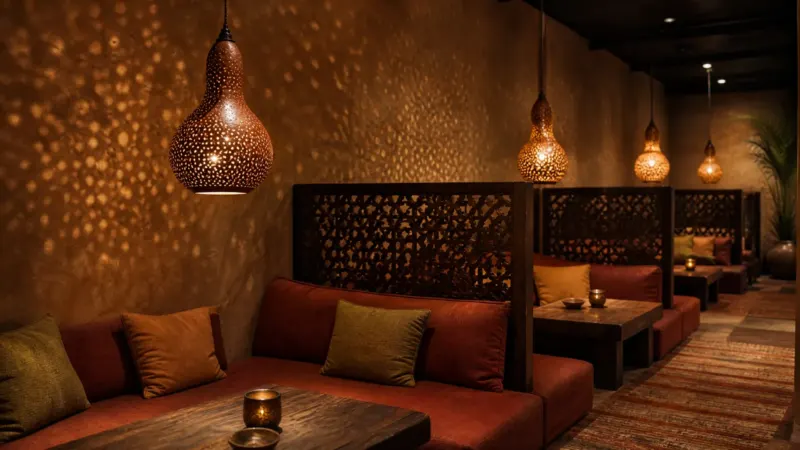
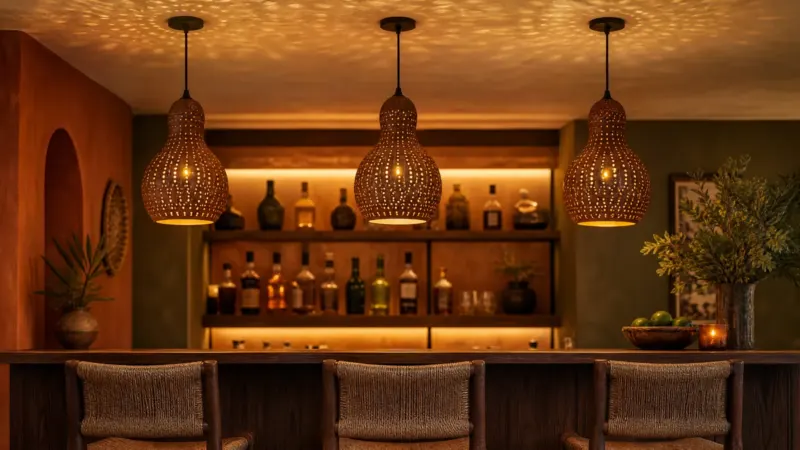
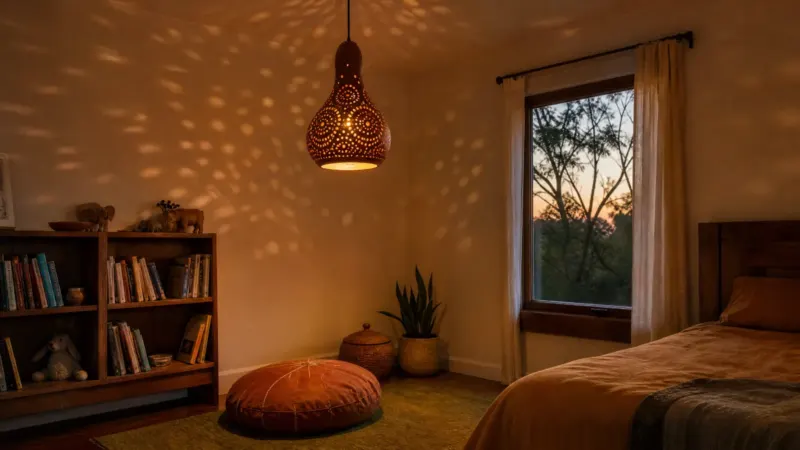
A carved shell does something else. The shell is opaque, so light escapes only through the drilled holes. Each hole works like a tiny projector, throwing a hard-edged spot that keeps growing and stays readable 1.5 to 2 meters away, often right across the ceiling. Because the holes were drilled by hand at slightly different angles and diameters, the spots differ in size and brightness. Beads set into some of them tint their spots turquoise, amber, deep blue. The pattern looks organized without being regular. That’s what a machine can’t produce cheaply.
If a listing shows a projected pattern, study the edges of the dots. Sharp and uneven means real holes. Soft and evenly spaced means a shade, or a Photoshop overlay.
| Molded or printed | Hand-carved shell | |
|---|---|---|
| Unit-to-unit difference | None visible | Shape, spacing, color |
| Edge of projected dots | Soft, uniform | Sharp, varied |
| Pattern reach | 30 to 40 cm | 1.5 to 2 m, ceiling included |
| Typical price | $40 to $120 | $200 to $400 |
| Time to your door | 2 to 5 days | 3 to 6 weeks |
Boho, Moroccan, and Turkish are three different things
Sellers use these words interchangeably. They shouldn’t. Moroccan lanterns are pierced sheet metal, usually brass or nickel-plated, cut in dense geometric star patterns. The light through them reads sharp and slightly cool, and the fixtures tend to hang rather than sit on a table.
Turkish mosaic lamps are a glass craft. Hundreds of cut colored glass pieces and beads get glued onto a clear globe and grouted, so the lamp glows in blocks of color instead of projecting onto your walls. We put the two side by side in gourd lamps vs Turkish mosaic lamps.
Boho isn’t a craft at all. It’s a way of putting a room together that borrows from many places, which is why a boho room can hold a Moroccan lantern, a mosaic lamp, both, or neither.
Gourd lamps come from the same part of the world as mosaic lamps, but they’re a separate craft with different materials and a different light. For what’s authentic and what’s a souvenir-shop copy, our Turkish lamps buyer’s guide covers it, and here’s how a gourd lamp is made.
What to expect from a handmade table lamp
- Yours won’t match the photo exactly. The design will. The specific shell won’t. If that bothers you, buy molded, no hard feelings.
- You’ll wait roughly a month, door to door.
- The price sits higher and flatter. Every table lamp we make is $279 with free worldwide shipping, plain zigzag or colorful pomegranate, because the hours per lamp land in the same place whichever pattern you pick.
- It’s repairable. Standard E27 socket with a CE certificate, 2 m cable with an inline on/off switch, 110-120V and 220-240V compatible. Nothing sealed shut.
- Some marks aren’t defects. Faint grain, a shell a few millimeters out of round, a bead sitting slightly proud of the surface.
Where to put it, with real numbers
Bedside. These lamps stand 25 to 35 cm tall. Most nightstands are 55 to 65 cm high, putting the top of the lamp between 80 and 100 cm off the floor. Sitting up in bed, your eyes are around 110 to 120 cm. That gap is the right one: you look down onto the pattern instead of into the bulb. Reading in bed, keep the lamp within 40 cm of your shoulder or the light won’t reach the page.
Console or sideboard. These run 75 to 85 cm. Leave 40 cm of clear wall above the lamp so the upward pattern has somewhere to land, and pull it 8 to 10 cm forward. Pushed flush to the wall, you lose half the projection.
Shelf. The trap is the shelf above. Under about 30 cm of headroom the pattern hits the underside and stops dead. Circumference runs 60 to 70 cm, so allow 25 cm of shelf depth.
Floor. Skip it. The cable is 2 m and you lose the wall wash that makes the lamp worth owning. For overhead light in the same style, that’s what a gourd chandelier is for. There are 13 of those.
The bulb decides how good it looks
People spend $279 on a lamp and then $2 on the wrong bulb.
- Color temperature: 2200K to 2700K. Above 3000K the wooden base goes gray and the amber beads lose their color.
- Keep the output low. A 2 to 4 watt LED, around 150 to 250 lumens. Fit an 800-lumen bulb and the holes stop reading as individual points, the wall pattern washes out, and you’re left with a glowing lump. Brighter is worse. Most common mistake by a distance.
- Smaller bulb, sharper pattern. A compact filament or candle-shaped LED throws crisper spots than a big frosted globe, the same reason a bare bulb casts hard shadows and an overcast sky casts none.
- Dimming. The inline switch is on/off only, so use a plug-in dimmer or a dimmable smart bulb.
- Avoid halogen and incandescent above roughly 25 watts equivalent. Heat inside a dried shell is a needless risk, and LED already gives the low output you want.
Living with natural materials
Dried gourd is stable. It’s still a plant.
- Humidity. Between 40 and 60 percent keeps it happy. Bathrooms and unheated sunrooms are the rooms to avoid. Fast swings matter more than the number, since a shell that dries quickly can pick up hairline cracks.
- Dusting. A dry soft brush worked over and around the holes. An old makeup brush is ideal. No damp cloths, no alcohol, no solvents. They lift the finish and soften the glue holding the beads.
- Sunlight. Painted colors fade over years on a south-facing sill.
- Once a year, run a fingernail over the beads. If one shifts, a dot of clear craft glue puts it back for good.
- The wooden base wants what any wood furniture wants. Dry cloth, no standing water.
So: if you want a rustic table lamp shape cheaply and don’t mind that it’s one of fifty thousand, buy the molded one. If you want unique table lamps in the literal sense, expect a longer wait and a bigger number at checkout. Both are reasonable buys.
Frequently asked questions
How can I tell if a boho table lamp is handmade?
Compare two photos in the same listing. A handmade piece won’t line up between angles because hole spacing, shell curve and bead placement all shift. Then zoom in on the drilled holes: hand work leaves slightly ragged rims and uneven spacing, while molded holes are perfect circles with a soft rounded lip.
What bulb works best in a carved gourd lamp?
A 2 to 4 watt LED at 2200K to 2700K, roughly 150 to 250 lumens, in the standard E27 socket. Low output matters more than anything else. A bright bulb floods the shell so the holes stop reading as points and the wall pattern washes out completely.
Why do handmade bohemian lamps cost more than mass-produced ones?
A factory spreads its mold cost across tens of thousands of identical units. A handmade lamp carries the actual hours spent drying the gourd, drilling every hole and setting each bead by hand. Our table lamps are $279 with free worldwide shipping, made to order in 5 to 7 days.
How high should a boho table lamp sit beside a bed?
On a 55 to 65 cm nightstand, a 25 to 35 cm lamp puts its top at 80 to 100 cm off the floor. Sitting up in bed your eyes sit near 110 to 120 cm, so you look down onto the pattern rather than into the bulb.
Does a gourd lamp need special care?
Keep it between 40 and 60 percent humidity and out of bathrooms, since fast drying can cause hairline cracks. Dust with a dry soft brush worked around the holes. Skip damp cloths, alcohol and solvents, which lift the surface finish and loosen the glue holding the beads.
All 17 carved designs sit in the table lamp collection, each $279 with free worldwide shipping. Start with the owl, the starfish, and the turquoise drops. Those throw the boldest patterns, and the photos are of the real lamps.