White Gourd Lamp or Natural: How to Choose the Finish
Every lamp in our shop has a small color choice on the listing: Natural or White. Most people pick in seconds, and a few email to ask which is better. This is the long answer for anyone weighing a white gourd lamp against the natural finish, from our workshop in Bodrum, where we have made gourd lamps for more than ten years.
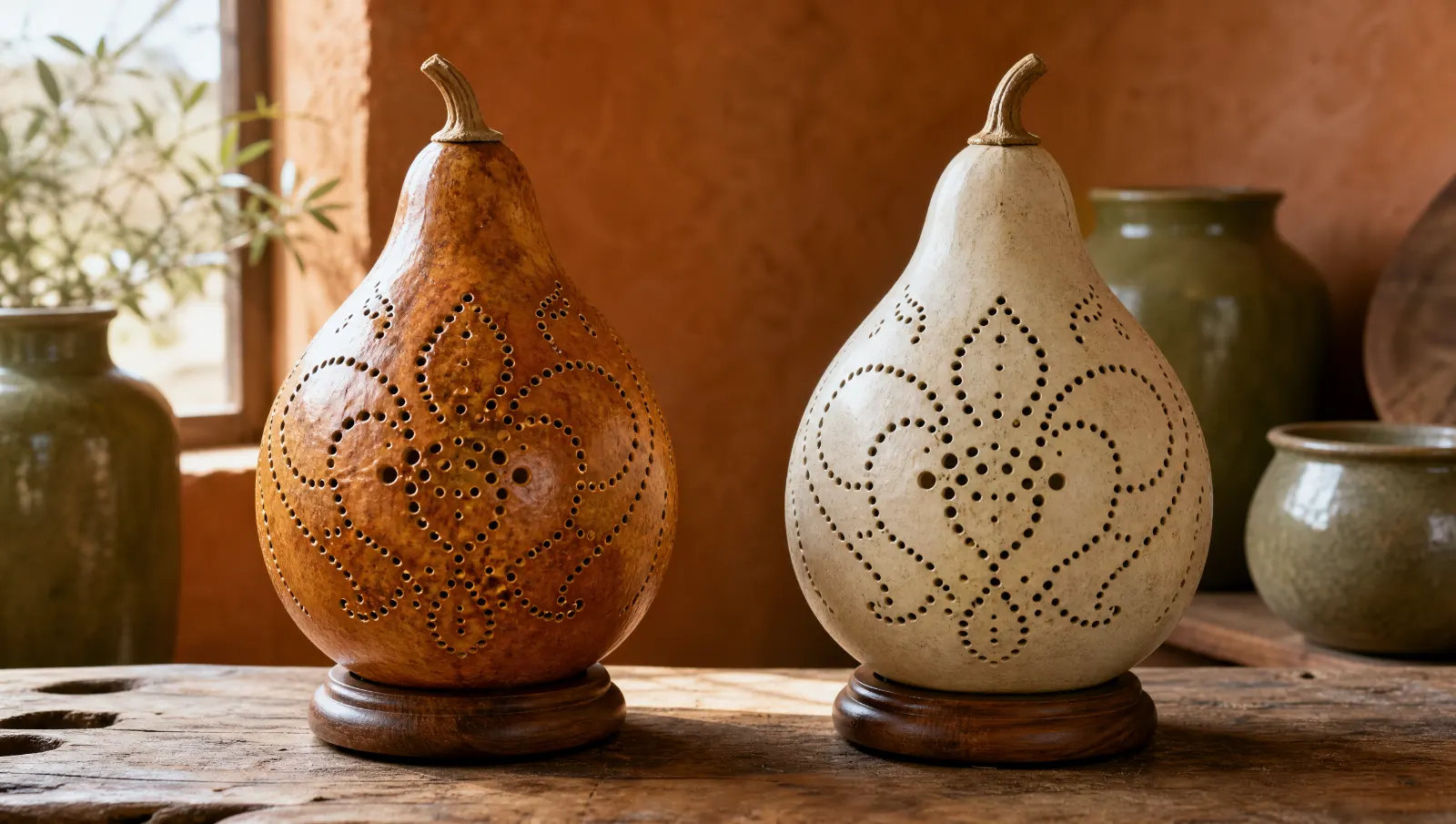
Short version: natural gives a warmer, slightly dimmer amber glow and suits earthy rooms. White reads brighter and cleaner, and it suits pale, pared-back rooms. Neither finish changes what the lamp is for, and neither will match the listing photo exactly.
White gourd lamp or natural: what the choice actually is
The choice applies to the gourd shell, the carved body of the lamp. The design and the price stay the same: every piece is $279 in either finish, with free worldwide shipping.
Natural is dried bottle gourd (Lagenaria siceraria), carved and varnished, in whatever shade that particular gourd grew. That runs from pale honey to deep amber-brown. White is the same kind of carved gourd with the shell finished white.
The finish is cosmetic. A white shell won’t turn the lamp into a reading light, and it is no tougher than natural. Dropped on a tile floor, either one can crack. The electrics are identical too.
What “white” means on a gourd lamp
White here means a finished white shell. Dried gourd isn’t naturally white. Even pale gourds tend to be a light tan, often with darker mottling, so a white lamp has been finished that way on purpose.
It isn’t one exact shade. Finishes vary from piece to piece, and some lamps look brighter while others lean toward a soft off-white. The texture of the gourd skin still shows through, with small ridges and the slight unevenness of something that grew in a field. If you are picturing the flat, uniform white of a glazed ceramic lamp or a freshly painted wall, a white gourd lamp won’t look like that up close.
The carved holes and cut shapes go right through the shell, so the pattern itself doesn’t change with the finish. On designs with hand-set glass beads, the beads sit in a white shell the same way they sit in a natural one.
How the finish changes the light
Switch on a gourd lamp in a dark room and most of what you notice is the pattern: dots and shapes thrown onto the walls and ceiling through the carved openings. Both finishes do that. The difference is in the color of the glow around the lamp and how the body looks when it is lit from inside.
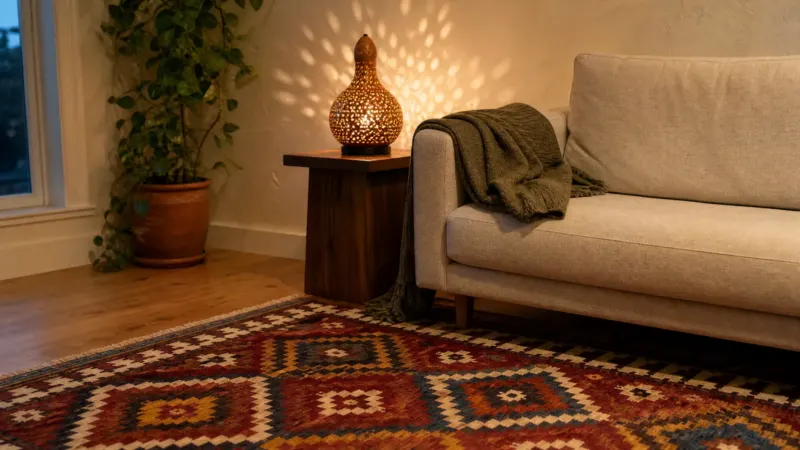
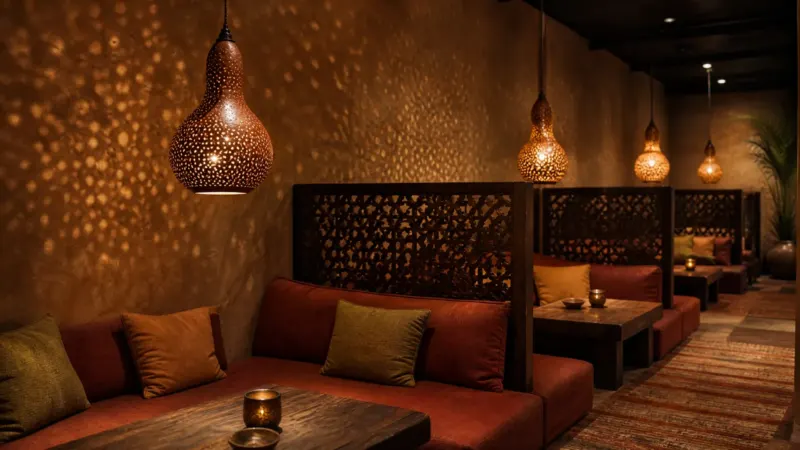
Natural gives an amber glow. The light around the openings picks up the gourd’s warm brown, so the lamp as a whole reads warmer and a little dimmer. In a dark room it looks like a lantern. Opinion: this is the look most people picture when they think of a gourd lamp, and it is the more forgiving of the two late at night.
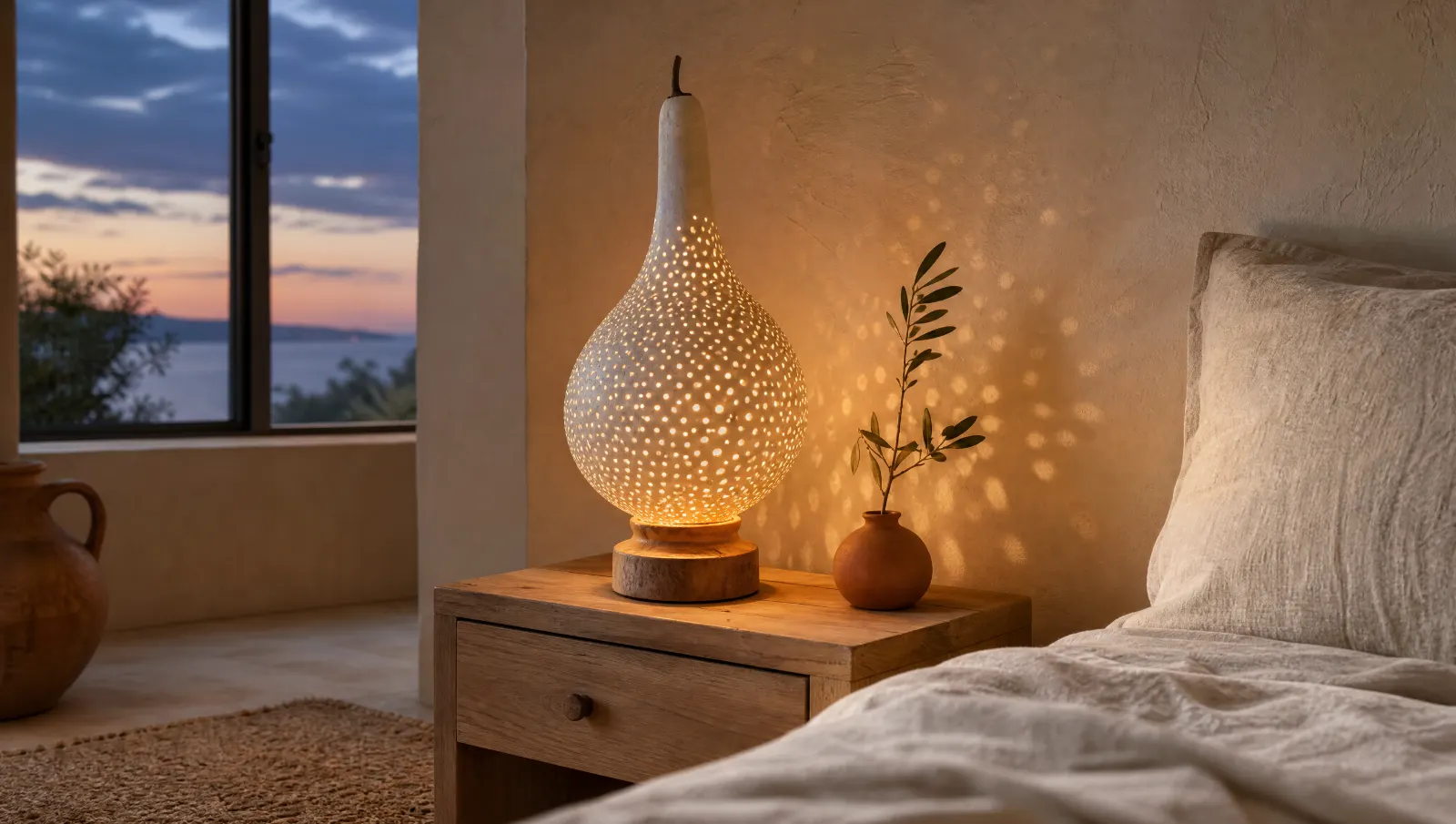
White reads brighter and cleaner. The glow sits closer to the color of the bulb itself, and the shell looks pale rather than amber, so the room feels a shade brighter. It is still a mood lamp. It won’t give you enough light to read by, and a brighter bulb mostly washes out the pattern.
By day, with the lamp off, the two finishes differ the most. A natural lamp is a dark, warm object that draws the eye on a pale surface. A white lamp carries less visual weight, and on a white table against a white wall it can almost disappear. Some people want exactly that.
Bulb pairing for each finish
Our house line on bulbs is the same for both finishes: a warm white LED between 2200K and 2700K, 4 to 8 W (40W-equivalent or lower), and no incandescent or halogen bulbs inside a gourd. My view, and it is only a view: natural lamps look richest toward 2200K, and white lamps look best near 2700K, which keeps them clean without drifting into cold office light. A cool daylight bulb in a white lamp is the quickest way to make it look clinical. More on bases and color temperature in our post on what type of bulb to use in a Turkish lamp.
Natural vs white compared
This is the side-by-side we send people who ask. It comes from workshop experience, not lab measurements.
| Point | Natural | White |
|---|---|---|
| Shell color | Honey to amber-brown, varies by gourd | Finished white; shade varies from piece to piece |
| Glow when lit | Warm amber, a little dimmer | Brighter and cleaner, closer to the bulb color |
| By day, lamp off | Dark and warm; stands out on pale surfaces | Light; blends into pale rooms |
| Bulb (opinion) | Warm white LED toward 2200K | Warm white LED near 2700K |
| Styles | Warm earth, boho, Turkish | Scandinavian, coastal, Greek island, minimalist |
| Walls and wood | Terracotta, ochre, olive; dark woods | White or pale walls; light woods |
| Over the years | Can deepen and warm | Shows dust and scuffs sooner |
| Glass beads | Colors read softer against brown | Colors contrast more against white |
| Matches the photo | Not exactly; gourd color varies | Not exactly; finish and screens vary |
| Price | $279 | $279 |
Rooms and styles that suit a white gourd lamp
White earns its place in rooms built on pale surfaces and restraint. These are the styles where we see it work best.
- Scandinavian. Light oak, white walls and few objects. A natural gourd can look like a visitor from another house here, while a white one reads as part of the room. The Daisy Gourd Table Lamp is a good fit for this kind of room in white.
- Coastal. Sand and pale blue with bleached wood. Sea designs make obvious sense, and in white the Starfish Gourd Table Lamp and the Fish Gourd Table Lamp lean more beach house than bazaar.
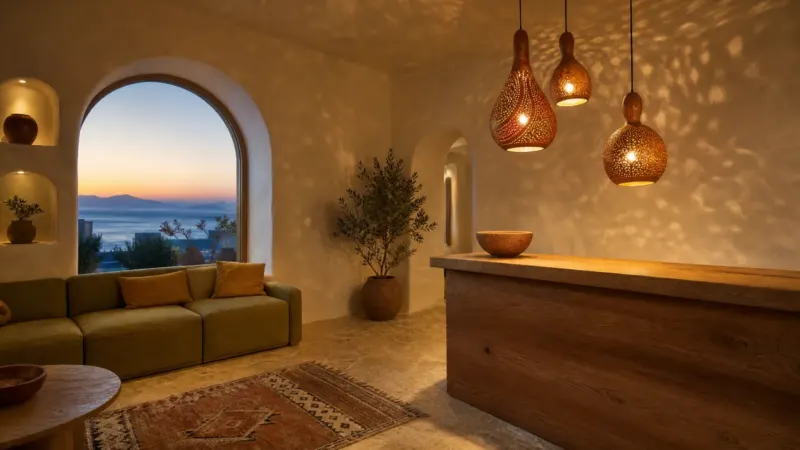
- Greek island. Whitewashed walls and blue shutters. A white shell against lime-white walls looks at home, and the pattern shows up well on those pale surfaces at night. The wider look is covered in our Mediterranean home decor guide.
- Minimalist. Clear surfaces and a neutral palette. A white gourd lamp adds pattern and shape without adding a heavy dark mass.
The walls matter more than the style label. On a white or pale wall, a white lamp stays quiet by day, and at night the dotted pattern has a clean surface to land on. If your room is pale but you want the lamp to be the one warm, dark object in it, that is a reason to choose natural instead.
Coastal style tends to spill into the bathroom and onto the terrace. The lamp shouldn’t follow it. Gourd lamps are not for bathrooms, damp spaces or uncovered outdoor use, whatever the finish.
Rooms and styles that suit natural
Natural belongs in rooms that are already warm, where the gourd’s own color does most of the work.
- Warm earth palettes. Terracotta, ochre, rust and olive, clay or plaster walls. A natural lamp sits among these colors without any effort.
- Boho. Layered textiles, rattan, plants, patterned rugs. The amber glow suits all that layering, and a white lamp can look too crisp against it.
- Turkish rooms. Kilims, brass trays, carved wood, deep reds. This is the tradition our workshop comes from, and natural is the classic look in it.
- Dark woods. Walnut and dark-stained oak. Natural gourd tones sit comfortably beside dark wood. White against walnut makes a strong contrast, which is fine if that is the point.
Natural is also the easier finish for rooms that change. It gets along with most wood tones and most warm colors, so if you repaint or move house, it is less likely to end up fighting the room.
How each finish ages
Both finishes want the same basic care: a dry soft brush for dust, no water, no spray cleaners, and no strong direct sun. Our gourd lamp cleaning and care guide has the details. What differs is what you notice after a few years.
Natural can deepen. Gourd is a plant material, and a natural shell can darken and warm slightly over time. It looks like age rather than damage. Keep it out of strong direct sun anyway, since sunlight fades the dyes on colored designs over the years.
White shows more. Dust sits on a white shell in plain sight, especially inside the carved openings and around beads, so a white lamp wants brushing more often. Scuffs and small knocks show up in a way they don’t on brown. Please don’t try to scrub a mark off with a damp cloth. Water is bad for gourd in either finish.
If the lamp is going into a busy hallway where people brush past it, or onto a side table a cat inspects every morning, natural hides the evidence better.
Photos versus the lamp on your table
This is the part we most want buyers to read. Neither finish will match the listing photo exactly.
Every gourd differs in shape, color and pattern, because every gourd grew differently. Photos of white objects add another layer of uncertainty, since camera white balance and your own screen both shift how white looks. A shell that photographs bright white can look softer and creamier under a 2700K bulb in your living room. Natural photos drift too, between honey and deeper brown.
Some practical checks before ordering:
- Look at your walls and main furniture in the evening light you actually use. Warm lamplight makes almost any white look cream.
- Read the dimensions. A table lamp gourd is about 7.5 to 9 in (20-23 cm) across and 10 to 14 in (25-35 cm) tall.
- Don’t try to match an existing white, such as your trim or a ceramic vase. Aim for a white that sits comfortably beside it, because a handmade gourd can’t promise an exact match.
We can’t take returns, exchanges or cancellations, so choosing the finish carefully matters more here than it would at a big-box store. If a lamp arrives damaged, defective or wrong, contact us right away and we will make it right. A white that turns out a little creamier than you pictured is normal variation, so look at the photos and dimensions carefully first.
If you can’t decide, choose natural
Opinion, and it is only an opinion: if you have gone back and forth more than twice, order natural. It hides dust and knocks, and it suits more rooms than white does. White is the better choice when you know your room is pale and want the lamp to blend in. When you aren’t sure, natural is the lower-risk pick.
Frequently asked questions
Is a white gourd lamp brighter than a natural one?
It reads brighter and cleaner, because the glow around the openings is not tinted amber by a brown shell. It is still a low-output mood lamp on a 4 to 8 W LED, and neither finish gives enough light to read by.
Does the white finish cost more?
No. Every lamp in our shop is $279 in either finish, with free worldwide shipping. Where customs duties or import taxes apply, the buyer pays them.
Will my white lamp look exactly like the photo?
No. White finishes vary from piece to piece, and screens show white differently. Expect the same design in a shade close to the photo, not an exact copy.
How do I clean a white gourd lamp?
Use a dry soft brush, and work it into the carved openings where dust collects. Don’t use water or spray cleaners on either finish, and keep the lamp out of strong direct sun.
Can I put a white gourd lamp in a coastal-style bathroom?
No. Gourd lamps in either finish are not made for bathrooms, damp spaces or uncovered outdoor areas. Put it in a dry room nearby, such as the bedroom or a hallway.
Are the hanging lamps offered in white too?
Yes. Every lamp in our range, table lamps and chandeliers alike, is offered in Natural or White on the listing.
Where to go next
If white suits your room, start with the designs mentioned above, the Starfish, Fish and Daisy table lamps, then browse all 17 in the gourd table lamps collection, where every listing lets you pick Natural or White. Budget for a warm white LED bulb, since there isn’t one in the box.