Turkish Gifts Beyond Turkish Delight: What to Buy and Skip

Most Turkish gifts start and end with a box of Turkish delight grabbed at the airport. The box is fine. It is also gone in a week. Turkey makes plenty of things that last longer and say more about the place, from flat-woven towels to copper coffee pots.
I run a small workshop in Bodrum that has made carved gourd lamps for more than ten years. The lamps are the only item here we sell. For everything else you get what a good one looks like, typical cost, how it travels, who it suits, and whether it is usually a factory-made souvenir. Quite a few are.
How to pick Turkish gifts that outlast the airport box
Start with whether handmade matters. A factory-made tea glass is exactly what Turkish families drink from, so it is authentic where it counts. A printed plate sold as hand-painted Iznik is different, because you are paying for a claim that isn’t true.
Then think about the journey. Glass and ceramics break in suitcases and in the post, while towels and copper survive almost anything.
On price, the ranges below are typical retail in US and European shops and online. Bazaar prices inside Turkey are often lower and open to bargaining.
Turkish towels (pestemal)
A pestemal is the thin, flat-woven towel used in Turkish hammams. It dries fast and folds to the size of a paperback.
What a good one looks like: 100 percent cotton or a cotton-linen blend, tightly and evenly woven, with firmly twisted fringes. A standard size is about 39 x 71 in (100 x 180 cm). Good ones feel a little stiff at first and soften with each wash. Cheap ones often contain polyester and barely absorb, so read the label.
Typical price and travel: $20-$60 outside Turkey. Nothing to break, light and flat.
Who it suits: beach people and anyone whose taste you only half know. It is the safest gift in this guide.
Candor: most pestemals sold abroad are machine-loomed, whatever the tag implies. A well-made machine-loomed towel is still a good towel. Pay handloom prices only when the seller can tell you who wove it.
Iznik-style ceramics
Iznik pottery means the tiles and vessels made in the town of Iznik from roughly the late 15th to the 17th century, in cobalt and turquoise on white. What you buy today is Iznik-style: new work in those patterns, made in Iznik, Kütahya and elsewhere.
What a good one looks like: hand painting shows in small variations. Lines thicken and thin, and two bowls from one set never match exactly. A transfer-printed piece has perfectly uniform lines.
Typical price and travel: $20-$80 for a small hand-painted bowl or tile, $60-$250 for a decorated plate. Fragile, so carry small pieces in hand luggage wrapped in clothing, or ask the shop to double-box.
Who it suits: hosts, and people who already have blue and white in the kitchen. One small bowl beats a set when you don’t know their shelves.
Candor: much of what tourist shops call hand-painted is a decal on ordinary clay. Ask whether a piece is food safe, too. If the seller can’t say, use it for keys or display.
Copper cezve and Turkish coffee
A cezve is the small long-handled pot for Turkish coffee, which is ground as fine as flour, heated slowly with water and poured grounds and all. With a fresh pack of coffee, it is a gift someone can use the next morning.
What a good one looks like: thick hammered copper that feels heavier than it looks, a lining inside (traditionally tin) and a handle that doesn’t wobble. Match the pot to the number of cups they usually make, since an oversized pot tends to give little foam.
Typical price and travel: $15-$60 for the pot, more for heavy handmade copper, and typically $5-$15 abroad for a 100-250 g (3.5-9 oz) pack of coffee. The pot is close to indestructible. Buy the coffee vacuum-packed, as it goes stale fast once opened, and check the destination’s rules on food.
Who it suits: coffee people who enjoy a small daily ritual. It is a weak gift for a drip-coffee commuter.
Candor and care: most souvenir cezves are pressed from thin copper in large batches. Never heat one empty, because a tin lining can melt, and plain copper won’t work on an induction cooktop.

Tea glasses and the double teapot
Turkish tea comes in small tulip-shaped glasses on saucers, brewed in a two-tier teapot called a çaydanlık. Water boils in the lower pot and strong tea steeps in the upper one, then each glass is diluted to taste.
What a good one looks like: clear, even glass with a smooth rim and saucers that sit flat. Gold-rimmed sets look festive, but gilding wears off in a dishwasher and rules out the microwave.
Typical price and travel: $15-$50 for six glasses with saucers, $25-$70 for a stainless steel çaydanlık. Fragile but cheap. Wrap each glass in a sock and pack them mid-suitcase.
Who it suits: tea drinkers and anyone who likes having people over. Add a pack of loose black Turkish tea.
Candor: these are factory-made, and that is fine. They are what Turkish homes actually use, which makes them more authentic than plenty of so-called handmade souvenirs.
Kilims: rugs, cushion covers and bags
A kilim is a flat-woven rug with no pile, woven by hand on a loom and traditionally made of wool.
What a good one looks like: the pattern looks nearly the same on the back as the front, and the fringes are the ends of the warp threads, not a strip sewn on. Ask about age and dyes, since some new kilims are washed or sun-faded to pass as vintage.
Typical price and travel: $30-$100 for a kilim cushion cover, $100-$400 for a small handwoven rug around 2 x 3 ft (60 x 90 cm); room-size pieces often start near $1,000. Unbreakable but heavy. A cushion cover fits a suitcase pocket, while larger rugs usually ship from the shop at a cost worth agreeing in writing.
Who it suits: people who already like pattern and color. A rug is a big decision to make for someone else, so a cushion cover is the easier gift. Our Turkish home decor styling guide shows how kilims sit in a room.
Candor: printed and machine-woven kilim-pattern rugs are everywhere, including in Turkey. They aren’t kilims and shouldn’t be priced like them.
Olive oil soap and evil eye pieces
Both are cheap, and both are easy to overdo.
Olive oil soap. The North Aegean coast around Ayvalık and Edremit is olive country. A good bar lists olive oil first in a short ingredient list and feels hard from curing. Typical price: $3-$10 a bar. It travels well, though bars sweat in heat. It suits nearly anyone, as a stocking stuffer or an add-on. Ignore health claims on the wrapper.
Evil eye (nazar) pieces. The blue glass eye is meant to turn away envy and bad luck, and many Turks hang one in a new home. A handmade bead has tiny bubbles and slightly uneven rings of blue and white. Typical price: $1-$5 for a small bead, $15-$50 for a larger handmade piece. Wrap the larger glass. It suits a new home. If it is for a baby, keep small beads away from the crib, since they are a choking hazard.
Candor: most nazar items are mass-produced, plenty outside Turkey, and a home covered in eyes stops meaning anything. One good piece is enough. Opinion: skip the nazar magnets entirely.
Mosaic lamps and carved gourd lamps
Lamps are the big-ticket Turkish gifts, and here I have a stake. Our workshop makes carved gourd lamps and sells nothing else. We don’t sell mosaic lamps.
Mosaic lamps are glass globes covered in small pieces of colored glass. A good one has pieces set close with tidy grout and wiring suited to your country. Mass-produced table lamps typically cost $40-$150, larger hand-built pieces more. They ship reasonably well in good packing, though a hard knock can loosen pieces. Most are assembled in volume, so the same lamp in many shops is normal. Our explainer on Turkish mosaic lamps covers how they are made.
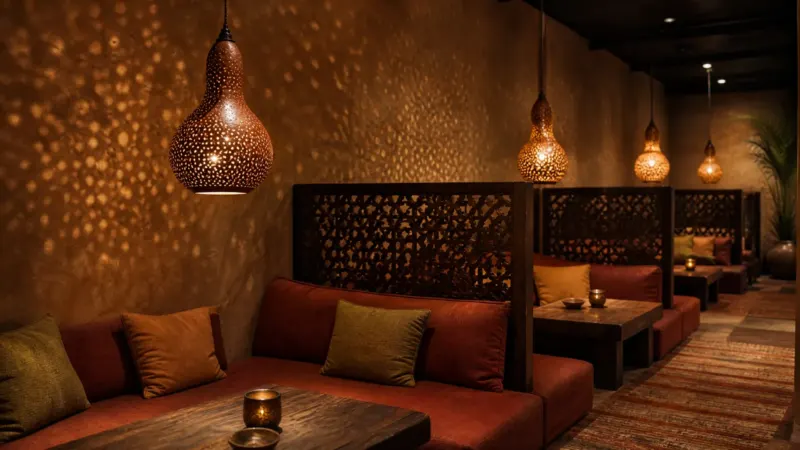
Carved gourd lamps are dried bottle gourds, drilled and carved in patterns, some with hand-set glass beads, then varnished. Look for clean, evenly spaced holes. Handmade ones typically sell for $150-$400, while resin lookalikes run $30-$90. Ours are all $279 with free worldwide shipping. A table lamp gourd is 7.5-9 in (20-23 cm) across and weighs about 2 lb (0.9 kg). It ships unassembled, wired for the destination’s plug and voltage. The bulb isn’t included; use a warm white LED at 2200K-2700K and 4-8 W. For a side-by-side look, read gourd lamps vs Turkish mosaic lamps.
The limits: a gourd lamp gives low, patterned light, so nobody reads by it. It won’t match the listing photo exactly, since every gourd differs. It can crack if dropped on a hard floor. We can’t accept returns, so look at photos and dimensions carefully first. A lamp is the wrong gift when:
- you don’t know the recipient’s taste well
- your budget is small
- they dislike objects on every surface
- they rent and move often
- a toddler in the house knocks things over
- they need a lamp to read by
Order-by note: production takes 5-7 days, then tracked express delivery typically takes 2 weeks, so allow about 3 weeks. For Christmas, order by about 15-20 November. After that, pick something else from this guide or give a card saying the lamp is on its way. The buyer pays any customs duties where they apply. Browse our gourd table lamps, or start with the Pomegranate Flower Gourd Table Lamp, since the pomegranate is a familiar motif in Turkish design.
Turkish gifts compared: price, shipping and who they suit
Prices are typical ranges outside Turkey, not quotes.
| Gift | Typical price | Fragility and shipping | Best for |
|---|---|---|---|
| Pestemal towel | $20-$60 | Unbreakable, folds flat | Unknown taste |
| Iznik-style bowl or plate | $20-$250 | Fragile; carry on or double box | Hosts |
| Copper cezve with coffee | $20-$75 | Pot sturdy; coffee has food rules | Coffee ritual fans |
| Tea glass set | $15-$50 | Fragile but cheap | Tea drinkers |
| Kilim cushion cover or small rug | $30-$400 | Unbreakable; rugs bulky | Pattern lovers |
| Olive oil soap | $3-$10 a bar | Easy | Almost anyone |
| Nazar glass piece | $1-$50 | Wrap larger glass | New homes |
| Mosaic table lamp | $40-$150 | Fragile; pack carefully | Colorful rooms |
| Carved gourd lamp | $150-$400 (ours $279) | Can crack if dropped | Known taste |
Usually factory-made: tea glasses, most nazar pieces, most souvenir cezves, many “hand-painted” ceramics, kilim-look rugs and boxed Turkish delight. That only matters when the price or label claims otherwise.
If you still want Turkish delight, buy it from a confectioner that makes its own. Opinion: the airport kind is made to keep for months, and tastes like it. For more ideas, see our guide to gifts under $300.
Frequently asked questions
Are Turkish towels worth the price?
A cotton or cotton-linen pestemal at $20-$60 is good value if it is tightly woven and free of polyester. Don’t pay handloom prices unless the seller can show who wove it.
Can I bring Turkish coffee and Turkish delight home in my luggage?
Many countries allow sealed commercial packs of coffee and sweets, but rules vary and some require you to declare all food. Check your own country’s customs guidance before you fly.
How can I tell if Iznik-style ceramics are hand-painted?
Look for small variations: lines that thicken and thin, dots of different sizes, no two pieces identical. Perfectly uniform lines, or a fine dot pattern under a magnifier, usually mean a printed decal.
When should I order a gourd lamp for Christmas?
By about 15-20 November. Production takes 5-7 days and delivery typically takes 2 weeks, so allow about 3 weeks. After that, give another gift or a card saying the lamp is on its way.
Do you sell Turkish towels, ceramics or mosaic lamps?
No. GourdLampDecor sells only carved gourd lamps: 17 table lamps and 13 chandeliers and pendant lights, all $279 with free worldwide shipping.
Where next
If a lamp is the gift, our guide to handmade gourd lamps covers carving quality and sizes. If it isn’t, a pestemal and a bar of olive oil soap make a fine pair for well under $100.