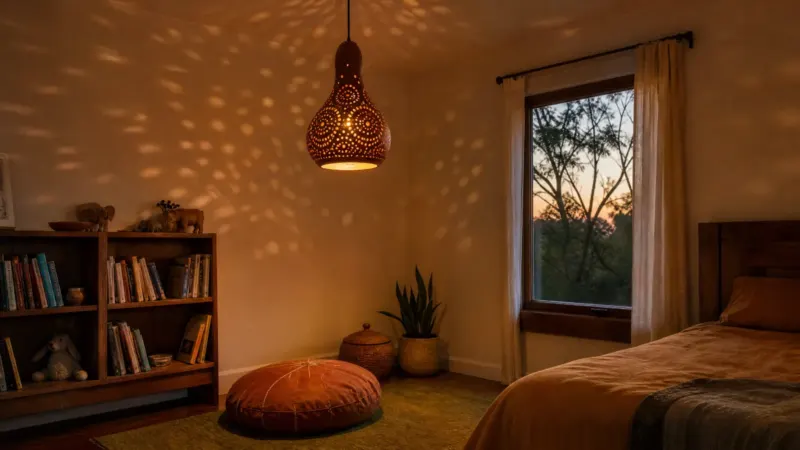
Moroccan Pendant Lights: How to Choose, Hang and Live With One

Choosing a Moroccan pendant light is the easy part. Almost every one of them looks good in a photograph. The hard part starts after the box arrives: how high to hang it, how many you need, whether your ceiling will take the weight, and what happens to that beautiful pierced pattern when it meets a low white ceiling in a room with a bright overhead already on. Those are the questions this piece answers, because the style guides do not.
If you are still deciding between styles rather than planning an install, the comparison of Moroccan, Turkish and boho lamp styles is the better starting point. Come back here once you know what you are hanging.
The two builds sold as a Moroccan pendant light
The classic is a pierced metal lantern. Brass or nickel-plated steel, cut or punched with a geometric pattern, sometimes with panels of coloured glass behind the piercing. It throws sharp, hard-edged shapes onto the ceiling and walls. It is also heavy: a mid-size one runs 2 to 4kg, and the large ones go past 6kg.
The second build is a pierced organic shade: a dried gourd shell, hand-carved with hundreds of holes, sometimes set with coloured glass beads. Same principle, very different physics. A carved shell pendant of the same visual size weighs between 500g and 1.2kg. On an old ceiling, or on a rented flat’s existing rose, that difference decides whether you can hang it at all.
Both throw a pattern. The metal lantern’s pattern is graphic and geometric. The carved shell’s is a field of points, softer and denser, and it moves differently as you walk under it. Neither is better. They suit different rooms.
Drop height, by location
This is the number people get wrong, and it is the one that decides whether the light feels designed or accidental. Drop height means the distance from the ceiling to the bottom of the shade, except over a table, where the useful measurement is from the tabletop up.
| Location | Measure from | Target gap | Spacing if using more than one |
|---|---|---|---|
| Dining table | Tabletop | 75–90cm | 75cm between centres |
| Kitchen island | Countertop | 75–85cm | 75–80cm between centres |
| Entryway | Floor | At least 210cm clearance | Usually one, centred |
| Bedside (hung instead of a lamp) | Mattress top | 50–65cm | Match your bedside table centres |
| Stairwell | Highest step nosing | At least 210cm | Single, or a staggered cluster |
| Over a bath (never a shower) | Floor | Check local regulations first | — |
Two corrections to those numbers. If your ceiling is above 270cm, add roughly 8cm of drop for every additional 30cm of ceiling height. And if the pendant is wide, over about 45cm across, hang it slightly higher than the table above suggests, or the people opposite each other lose eye contact.
How many, and how far apart
A rough rule that has served me well: one pendant per 90cm of table or island length, with a minimum of 30cm from the end of the run to the centre of the outer pendant. A 180cm island takes two. A 240cm island takes three, or two large ones. Odd numbers look more relaxed than even numbers over a long run, which is a preference rather than a rule.
Mixing sizes in a cluster works if you vary the drop heights as well. Three identical pendants at three different heights reads as deliberate. Three different pendants at the same height reads as a mistake.
Ceiling boxes, weight limits and the brace question
A standard ceiling electrical box is rated for a fixture weight that is a lot lower than most people assume. In North America the common rating is 50 pounds, roughly 22kg, but only where the box is properly fixed to a joist. A box mounted to a plasterboard ceiling with no structural fixing behind it is rated for far less, often 15 pounds or around 7kg, and plenty of older installs are rated for nothing at all because they were never intended to carry a fixture.
Practical guidance: under 3kg, a properly fixed standard box is fine. Between 3 and 10kg, check that the box is fixed to a joist or fit a brace bar. Over 10kg, fit a fan-rated brace regardless of what the existing box looks like. If you cannot see how the box is fixed without opening the ceiling, assume the worst.
This is where the weight of the shade stops being an aesthetic detail. A carved shell pendant at under a kilo needs none of this. A large brass lantern very well might.
When there is no box overhead
Common in bedrooms, in rentals, and over any table that is not centred under the existing fitting. The swag approach solves it: hang the pendant from a ceiling hook positioned where you want the light, run the cable across to the existing rose or to a wall outlet, and use a cord cover or a matched fabric cable so the run reads as intentional.
Two things make the difference between this looking considered and looking like a bodge. First, the hook must go into a joist or a proper cavity anchor, because a plain plasterboard plug will pull out eventually. Second, the cable run should follow a straight line and terminate somewhere logical. A diagonal swoop across a ceiling never looks right.
A plug-in swag pendant is also the only version of this that a renter can install and take with them, which is worth more than it sounds.
What the ceiling does to the pattern
The pierced-shade effect is a projection, and like any projection it depends on the screen. Three variables change the result more than the lamp itself does.
- Ceiling colour. Flat white gives the highest contrast. A warm off-white softens it pleasantly. A dark ceiling swallows the pattern almost entirely. If your ceiling is charcoal, the pendant becomes a glowing object rather than a projector, which may be exactly what you want, but know it going in.
- Ceiling texture. Smooth plaster holds the pattern. Heavy texture or an artex finish breaks it up into noise.
- Distance. The closer the shade to the ceiling, the smaller and sharper the pattern. Drop it lower and the pattern spreads and softens. A 20cm change in drop height visibly changes the effect, which is worth playing with before you make the fixing permanent.
Bulb choice, which matters more here than anywhere
A frosted bulb behind a pierced shade produces a soft glow and throws almost no pattern. A clear filament-style LED behaves as a point source and throws a sharp one. This single choice is the difference between a pendant that paints your ceiling and one that just sits there looking nice.
Specifics: clear glass, 2700K, 4 to 6 watts, E26 or E27 depending on your country. A vintage-style filament with a long straight filament array gives a slightly different pattern to a compact globe filament, and it is worth buying one of each for a few pounds to see which you prefer in your room.
On dimming: buy a bulb explicitly marked dimmable and a dimmer rated for LED loads. A cheap trailing-edge dimmer with a non-dimmable LED flickers, and the flicker is far more obvious under a pierced shade because the pattern on the ceiling amplifies it.
Cleaning a pierced shade
Dust collects on the inside edge of every hole and gradually mutes the pattern. Twice a year is enough for most homes.
For metal: switch off, let it cool, and use a soft dry paintbrush to work the dust out of the piercing, then a vacuum on the lowest setting held a few centimetres away to catch it. Avoid wet cloths on unlacquered brass, which will mark.
For a carved shell shade: dry brush only. No water, no polish, no oil. The shell is organic and will absorb whatever you put on it. The full method is in the cleaning and care guide, and the short version is that a paintbrush and patience are the entire toolkit.
Cords, canopies and the details that decide whether it looks finished
Three small things separate a pendant that looks installed from one that looks hung.
The canopy, first. That is the shallow cover where the fixture meets the ceiling. A canopy that does not sit flush, or that shows a gap on one side because the ceiling is not level, is the single most visible flaw in an otherwise good install. A thin ring of paintable flexible sealant closes it, and takes two minutes.
Cord colour, second. Most pendants ship with black or clear plastic flex. Against a white ceiling, black flex draws a hard line straight to the fixture. Braided fabric cable in a colour close to your ceiling costs very little and removes the line almost entirely. If the pendant is a warm natural material, a natural jute or linen-wrapped cable suits it better than either black or white.
Cord length, third. Buy longer than you need and shorten it. Almost every pendant sold internationally comes with either too little cable or a fixed drop, and shortening is a two-minute job while lengthening means splicing. If the seller offers a choice of drop, order at least 20cm more than your calculation.
One more, for hanging lamps in a natural material: check what the fixture actually hangs from. A carved shell shade should carry its weight on the metal fitting or a proper suspension ring, not on the shell itself. If the shell is loaded directly, it will eventually crack around the hole. The piece on how these are built shows where the load goes.
Common questions about Moroccan pendant lights
How low should a Moroccan pendant light hang over a dining table?
Between 75 and 90cm above the tabletop, not above the floor. That gap lights the table without sitting in the eyeline of people across from each other. Add roughly 8cm for every 30cm your ceiling is above 270cm, and hang wide shades slightly higher.
How many pendants do I need over a kitchen island?
Roughly one per 90cm of island length, spaced 75 to 80cm between centres, with at least 30cm from the end of the island to the outer pendant. A 180cm island takes two; a 240cm island takes three, or two larger ones.
Can I hang a pendant where there is no ceiling box?
Yes, using a swag hook fixed into a joist or a proper cavity anchor, with the cable run across to the existing rose or a wall outlet and covered or matched so it reads as deliberate. Plug-in swag pendants are the only version a renter can install and take with them.
What bulb gives the sharpest pattern through a pierced shade?
A clear filament-style LED, 2700K, 4 to 6 watts. It acts as a point source and casts hard-edged shapes. A frosted bulb diffuses the light before it reaches the piercing and produces a soft glow with almost no pattern.
How heavy is too heavy for a ceiling box?
Under 3kg is fine on any properly fixed standard box. Between 3 and 10kg, confirm the box is fixed to a joist or fit a brace bar. Over 10kg, fit a fan-rated brace. Boxes attached only to plasterboard carry far less than their nominal rating.
If a lightweight pierced pendant is what your ceiling can take, the carved gourd chandeliers and pendant lights all sit under about 1.2kg and hang from a standard box without any bracing, and the hanging lamp buyer’s guide covers the range in more detail.