Mediterranean Bedroom Decor: Linen, Limewash and Low Warm Light

Mediterranean bedroom decor is mostly subtraction. You take out the heavy things and let rough surfaces and warm, low light carry the room at night. The style comes from hot coastal houses where thick walls and shutters kept a bedroom bearable in August, and it works best when you copy the reasons along with the look.
We make carved gourd lamps in Bodrum, Turkey, and our Mediterranean home decor guide covers the whole house. This one stays in the bedroom.
What Mediterranean bedroom decor looks like in a real room
Picture softly textured white walls, a wooden or iron bed in rumpled linen, a cool tile floor with a flat rug, and shutters holding back the afternoon sun. Colors come from the landscape: chalk white, sand, olive and faded terracotta, with a little sea blue. Nothing is shiny.
The rooms this comes from were built for heat, so they are sparse. A bed, a nightstand or two, a chest, and a few things made by hand. Opinion: one clay pot and one lamp with some character do more than a shelf of coastal ornaments.
Greek island bedrooms lean white and blue. Turkish Aegean rooms, like the ones around our workshop, run warmer, with terracotta floors and kilims.
The bed: washed linen, cotton and light layers
The bed is the biggest surface in the room, so bedding sets the tone. Washed linen is the classic choice. It sleeps cool and gets softer with washing. It also wrinkles, which is part of the look. If wrinkles bother you, linen will bother you, and that is a fine reason to skip it.
Cotton is the practical alternative. Percale is crisp and cool, sateen smoother and slightly warmer, and both usually cost less than good linen. A white or oatmeal cotton set with a linen throw at the foot gets you most of the effect.
Layer light rather than thick, with a cotton waffle blanket and a lightweight coverlet you can add or remove through the year. In a cold-winter climate, a natural wool blanket fits the style better than a puffy synthetic comforter. Keep it to one colored layer, and two sleeping pillows with a cushion or two. A pile of eight decorative pillows looks like a hotel, and not a Greek one.
Walls: limewash, plaster texture and color
Original Mediterranean walls are lime-plastered or whitewashed, with soft variation in tone, and flat smooth paint looks like a rental next to them.
Limewash is the easiest route. It is a mineral paint made from lime, brushed on in loose overlapping strokes, and it dries to a cloudy, chalky finish. It bonds best to porous surfaces such as plaster and brick. On ordinary painted drywall you usually need a mineral primer first, so read the product instructions. Limewash is less scrubbable than latex and can mark when rubbed, which matters behind a headboard.
A lime plaster finish gives more depth, but it is a skilled trade, and a rough DIY attempt shows. If the budget covers one wall, do the one behind the bed.
Warm whites and pale sand tones are the safe colors. A soft clay wash helps a north-facing room. Opinion: keep blue for textiles and pottery, because a blue wall in a room without strong daylight can turn gloomy.
Floors: terracotta, stone and jute
Mediterranean floors are hard and cool. In a Chicago January, bare tile beside the bed is miserable, so most people outside the Mediterranean add a rug.
Real terracotta is porous and needs sealing. Without radiant heating it stays cold underfoot. It darkens with wear. If you are not retiling, porcelain tile with a terracotta or stone look is tougher and easier to clean, and warm or whitewashed wood suits the style too.
Jute and sisal rugs give the right texture cheaply. They are coarse on bare feet and dislike water, since spills mark and a damp jute rug can mildew. A flatweave wool rug or faded kilim is kinder where your feet land.

Windows: shutters and sheer linen
Interior louvered shutters are the most Mediterranean window treatment. You tilt the slats to cut glare without closing the room off. Painted wood looks more authentic than vinyl and costs more, and custom shutters are built to the opening, so measure carefully.
Sheer linen curtains are the lighter option. They filter sun into a soft glow, but they do not block light. If you sleep past sunrise, pair them with a blackout roller shade mounted inside the frame. Many linen curtains shrink if washed warm, so check the care label and buy a little long.
Furniture: wood, rattan and iron beds
The furniture is plain and sturdy. Solid wood in an oiled or whitewashed finish is the base, with rattan or wrought iron mixed in. Glossy lacquer and mirrored pieces belong in another room.
An iron bed is the classic statement. Bolted iron frames can squeak as the bolts loosen, and tightening them every few months fixes most of it. Rattan nightstands or a cane chair add lighter texture; keep rattan away from heating vents, which make it brittle.
Nightstand height matters for lighting. A nightstand close to the top of your mattress is the usual guideline, and it decides how tall the bedside lamp should be. Our lamp sizing guide works through the numbers.
Bedroom lighting: bedside lamps, wall lights or a low pendant
Lighting is the part people copy least well. The rooms in photos glow at night because they have several low, warm sources and the overhead light stays off. Switch on a single ceiling fixture and you flatten everything you did to the walls. There are three main ways to put light beside the bed, and your wiring and nightstand space decide between them.
Bedside table lamps
The simplest option. A table lamp plugs in and needs no electrician. The cost is nightstand space, since a wide base leaves little room for a book and a glass of water.
Wall lights
Sconces clear the nightstand and put light at a useful height. Plug-in sconces with a cord cover work for renters. Hardwired sconces look cleaner and should be installed by a licensed electrician. A swing-arm sconce makes the best bedside reading light, because you aim it at the page.
A low pendant beside the bed
A pendant hanging beside the bed frees the nightstand and looks at home in this style. Hang it to clear your head when you sit up, and mock the height with string before drilling. Our guide on how to hang Turkish lamps covers hooks, swag kits and wiring. Our own pendants have an 80 cm (32 in) cable, so a low drop from a tall ceiling needs a longer cord or an electrician.
Bulbs: stay between 2200K and 2700K
Color temperature does more for the mood than the fixture. Warm white LED at 2200K to 2700K gives the late-sun tone; at 3000K and above the room starts to feel like an office. For decorative lamps, including ours, we recommend a warm white LED of 4 to 8 W (40W-equivalent or lower). The bulb guide for Turkish lamps has details, including dimmable options.
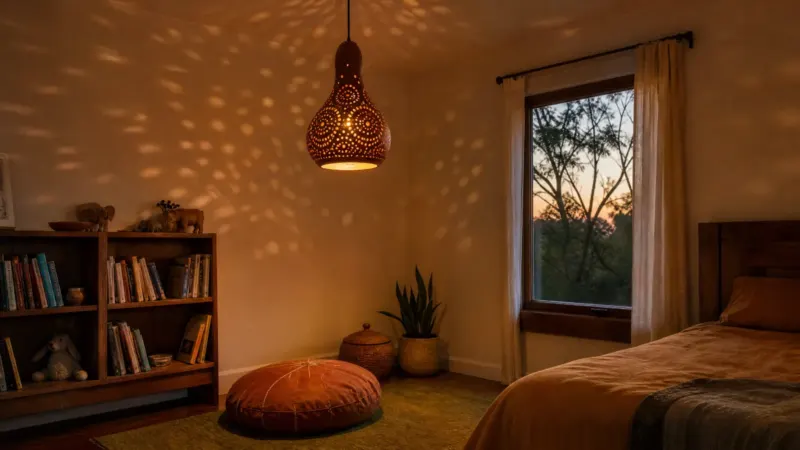
Patterned light on plaster walls
Here the walls and the lighting work together. A carved lamp near a limewashed or plastered wall throws dots that the uneven surface catches and softens. A few inches from the wall, the pattern stays small and crisp. Farther out, the dots grow larger and fainter. A clear filament-style bulb gives sharper edges than a frosted one.
Keep a separate reading light
This applies to our own products. A gourd lamp is atmosphere, and it is no reading light: the output is low and dotted, and reading by it tires your eyes. If you read in bed, add a swing-arm sconce or a lamp with a solid shade and a brighter 2700K bulb. And if there is room for only one bedside light and you read every night, buy the reading light and skip the gourd lamp.
Mediterranean bedroom elements by budget
All of this can be done in stages. Prices vary by country and store, so the table describes options rather than exact costs.
| Element | Low | Mid | Splurge |
|---|---|---|---|
| Bedding | White cotton percale set, one linen throw | Washed linen duvet cover and pillowcases | Full washed linen set with a wool blanket |
| Walls | Warm white matte paint | Limewash on the wall behind the bed | Lime plaster finish by a skilled plasterer |
| Floor | Large jute rug over the existing floor | Flatweave wool rug or vintage kilim | Sealed terracotta or stone tile, professionally laid |
| Windows | Linen-look sheers on an iron rod | Real linen sheers plus a blackout shade | Custom painted wood interior shutters |
| Furniture | Secondhand wooden nightstands, sanded and oiled | New iron bed frame | Solid wood or antique iron bed |
| Reading light | Thrifted ceramic lamp with a 2700K LED | Plug-in swing-arm sconces | Hardwired sconces fitted by a licensed electrician |
| Atmosphere light | Warm 2200K LED bulbs in lamps you own | One handmade carved lamp ($279 for ours) | A carved pendant beside the bed plus a carved table lamp |
Opinion: if you can spend properly in one place, spend on the walls or the bedding. They are the biggest surfaces, and cheap versions show.
Natural materials, damp climates and what gourd lamps can’t do
These materials behave well in the dry heat they come from. In a humid climate or a basement bedroom, they need more care.
- Linen and cotton: dry bedding fully before storing it, or it can mildew.
- Jute and sisal: they absorb moisture and can mildew or discolor. Use a wool or synthetic flatweave in damp rooms.
- Rattan: it can mold in constant humidity, so a dehumidifier helps.
- Limewash: generally tolerant of moisture, but flaking on a limewashed wall often points to damp behind it that needs fixing first.
- Gourd lamps: not for bathrooms or damp spaces. With an open en-suite, keep the lamp well away from the bathroom door, and off windowsills where condensation collects and strong sun fades the dyes.
A few more honest limits. The supplied switch is on/off, so dimming needs a dimmable bulb and a compatible dimmer. A gourd can crack if it is knocked onto a tile floor. Every gourd is different, so yours will not match the listing photo exactly. Because we can’t take returns, look at the photos and dimensions carefully before you order.
Frequently asked questions
What colors work best for Mediterranean bedroom decor?
Warm white or pale clay on the walls, with olive or faded terracotta in the textiles. Keep strong color to a rug or a throw and let texture carry the rest.
Can I get the Mediterranean look in a bedroom with carpet?
Yes. Lay a flatweave rug over low-pile carpet, or leave the floor alone and put the effort into limewashed walls and linen bedding. Those read as Mediterranean far more than the flooring does.
What color temperature bulb is best for a Mediterranean bedroom?
Warm white LED between 2200K and 2700K for ambient and decorative lamps. A brighter 2700K bulb suits a reading light. Avoid 4000K and daylight bulbs, which make plaster and linen look gray.
Is a gourd lamp bright enough to read by in bed?
No. Light leaves a gourd lamp through carved holes, so the output is low and patterned. Use it for atmosphere and add a swing-arm sconce or a lamp with a solid shade for reading.
Do natural materials work in a humid climate?
Linen and cotton cope well if the room is ventilated and bedding is stored dry. Jute and rattan are more likely to mildew in constant damp, so choose a wool or synthetic flatweave rug. Keep gourd lamps out of bathrooms and damp spaces altogether.
Where to go next with a Mediterranean bedroom
Start with bulbs and bedding, since both are quick to change, then work toward the walls. If your room pulls more boho than coastal, our older post on bohemian bedroom lighting with gourd lamps goes that way.
For the pattern-on-plaster effect, the Spiral Gourd Table Lamp suits a nightstand, and the Butterfly Gourd Chandelier can hang beside the bed. Every lamp is $279 with free worldwide shipping, in a Natural or White gourd; white sits well against whitewashed walls. Production takes 5 to 7 days and delivery typically 2 weeks. Bulbs are not included, so buy a warm LED while you wait.