How Are Turkish Lamps Made? Mosaic Glass, Metal and Gourd

How are Turkish lamps made? It depends on which Turkish lamp you mean. The name covers quite different objects: mosaic glass lamps built from hundreds of small colored pieces, pierced metal lanterns punched from sheet brass or copper, and carved gourd lamps cut from a dried vegetable shell. They share a bazaar and a warm, patterned light, and little else in the workshop.
A quick disclosure before the details. We are a gourd lamp workshop in Bodrum, Turkey, and have been making gourd lamps for more than ten years. We do not make or sell mosaic lamps or metal lanterns. What follows on those two is general trade knowledge, written conservatively, and practices vary a lot from one workshop to the next. If you want the definition first, what a Turkish mosaic lamp is has its own post.
How are Turkish lamps made: the short answer
- Mosaic glass lamps: a glass globe is covered with small pieces of colored glass and beads, set by hand in adhesive, then grouted, cleaned, fitted with metal parts and wired.
- Pierced metal lanterns: sheet brass or copper is marked with a pattern, punched or cut through, shaped into a body, joined, finished with a patina or polish, and wired.
- Carved gourd lamps: a dried bottle gourd is cleaned, drilled and carved, sometimes beaded, varnished and mounted on a base with a socket.
The mosaic lamp gets most of the space below, since it has the most steps.
Mosaic lamps, step one: the globe and the glass
A mosaic lamp starts with a blank form. For most table lamps and hanging lamps this is a glass globe, usually clear or frosted, with an opening at the top and bottom where the metal fittings attach later. Workshops generally buy these blanks. Shapes run from a plain ball to an onion dome, and the shape decides how the pattern flows.
Next comes the colored glass. Traditionally an artisan cuts sheets of colored glass into small pieces with a glass cutter and nippers, then sorts them by color into trays. Many workshops now buy pieces pre-cut in bulk, which saves hours. The pieces are typically a few millimeters to about a centimeter across (roughly 1/8 to 3/8 inch). Glass beads often outline a motif or run along a border, and being rounded, they catch light differently from flat glass.
Before any glass goes on, the globe is cleaned so the adhesive will grip. Some makers sketch guide lines on it; experienced hands often work traditional motifs largely from memory.
Laying the mosaic pattern by hand
This is the slow part, and on a genuinely handmade lamp it happens one piece at a time. The maker applies a clear adhesive to the globe or to the back of each piece and presses the glass into place, leaving a small, even gap between neighbors for grout. The type of adhesive varies by workshop, and I would be wary of anyone who names one correct product.
Most makers build the outline of the design first, often in beads or a contrasting color, and then fill the spaces inside it. Curved globes are the tricky bit. Flat pieces do not sit naturally on a sphere, so near the openings at the top and bottom the pieces get smaller and the gaps need careful handling, or the pattern drifts and the grout lines turn uneven.
Once the surface is covered, the adhesive is left to cure. That can mean a few hours or a night, depending on the glue and the weather.
Grouting and cleaning the glass
Grout fills the gaps between the pieces and locks them in. It is pressed in by hand or with a soft tool, and the excess is wiped off the face of the glass before it fully hardens. A dark grout tends to make the glass colors look sharper, and a pale grout softens the whole lamp. The grout mix itself varies by workshop, and there is no universal recipe.
After the grout sets, the glass is cleaned again, sometimes more than once, so no haze is left on the colored pieces. On a hurried lamp you can often see a cloudy film on the glass, or grout smeared over the edges of pieces, and that is the easiest quality check you can make from a close-up photo. The mosaic lamp buying guide goes further into what to inspect before you pay.

Metal fittings, chain and wiring
With the glass finished, the globe is joined to its metal parts. On a table lamp that means a stand or base, usually with a decorative cap on top. On a hanging lamp it means a top cap, a chain and a ceiling canopy, and a chandelier adds arms that carry several globes. These parts are commonly brass or brass-plated metal, with finishes from bright to antiqued, and a brass-colored base on its own tells you little about how carefully the glass was set.
Wiring is the final stage. A socket is fixed inside, the cable is run through the stand or along the chain, and table lamps get a plug and switch. Socket sizes vary. Many Turkish mosaic lamps use a small screw base, and some larger pieces take a standard household bulb, so check the listing before buying bulbs. For a lamp bought abroad, confirm the voltage and plug type. Anything hardwired into a ceiling should be installed by a licensed electrician.
Handmade vs factory-made mosaic lamps
Almost every Turkish mosaic lamp is hand assembled to some degree. The real difference between a $50 lamp and a much pricier one is how much of the process has been standardized, and how much care goes into the parts you can still see.
| Stage | Hand-built workshop lamp | Mass-produced lamp |
|---|---|---|
| Glass pieces | Often cut in the workshop, varied sizes | Pre-cut, uniform, bought in bulk |
| Globe | Bought blank, sometimes in less common shapes | Standard molded blanks in a few sizes |
| Pattern | Laid by one maker, sometimes freehand | Repeated from a template, often split between workers |
| Grout and cleaning | Worked slowly, cleaned closely | Faster; haze and smearing more common on cheap lamps |
| Metal parts | Heavier cast parts on some pieces | Light pressed or plated parts in standard designs |
| Wiring | Fitted per lamp | Ready-made socket and cable sets |
| Typical price | Larger pieces usually above $150 | Commonly $40-$150 for a table lamp |
What gets automated is mostly the preparation around the setting, not the setting itself. Pre-cut glass, molded globes, stamped bases and ready-made wiring sets all save hours, and dividing the work so one person glues while another grouts and wires saves more. None of that makes a factory lamp bad. My view, and it is only a view: at the low end, watch the grout lines and the weight of the fittings, because that is where speed shows first. Some very cheap lamps use glass that is painted or printed to look like mosaic, which is a different product altogether.
How pierced metal lanterns are made
Pierced lanterns start as flat sheet metal, usually brass or copper, with cheaper versions in plated steel or tin. The maker cuts the sheet to the outline of the lantern body, often from a template, and marks the pattern on it by drawing or stenciling.
The piercing is done with punches and small chisels struck with a hammer, over a backing that absorbs the blow. Each hole or slot takes a strike or a few, so a dense pattern means thousands of them. In factory production this is where automation arrives first. Stamping presses or laser cutting produce the same pattern in minutes, and the edges look more regular than hand-punched ones.
After piercing, the sheet is bent or hammered into shape, rolled into a cylinder or domed, and the seams are joined by soldering or riveting. A cap and hanging ring are added. The finish comes near the end: either a darkened patina that settles into the pattern, or a polish and lacquer to keep the metal bright. Then the socket and cable go in. That is the general route; individual workshops vary.
Carved gourd lamps: the short version
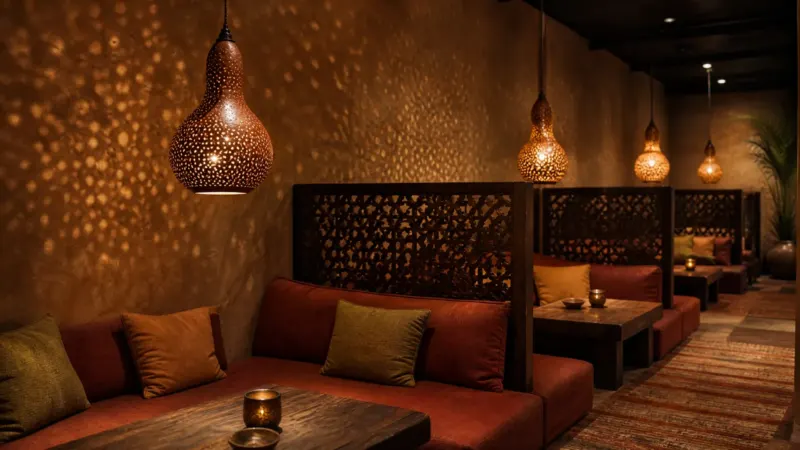
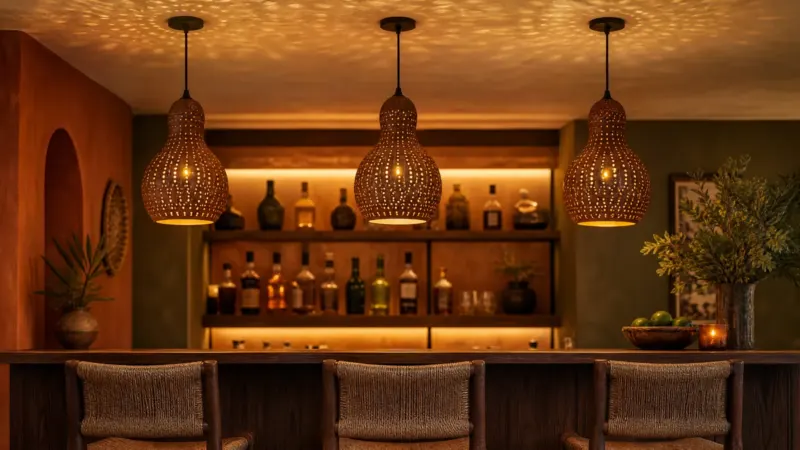
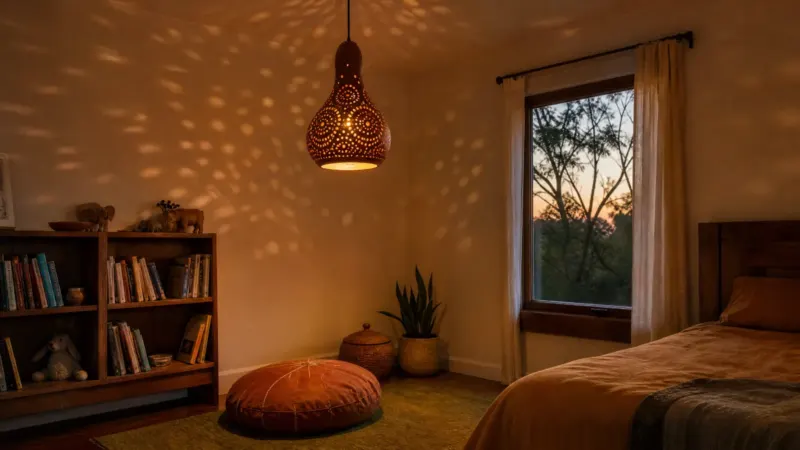
This is the one we actually make. A dried bottle gourd (Lagenaria siceraria) is cleaned inside and out, the pattern is drawn on the shell, and it is drilled and carved by hand. Some designs have glass beads set into the holes. The shell is varnished, and table lamps are fitted to a wooden base with an E27 socket and cable. Production takes 5-7 days after an order. Our full process is in how gourd lamps are made, and our post on handmade gourd lamps covers what handmade means in practice.
Two honest limits belong here. Every gourd grows differently, so no lamp will match its listing photo exactly in shape, color or pattern. And a gourd lamp is a pattern light with fairly low output, so it will not work as a reading lamp. If you want bright, even colored light across a table, a mosaic lamp does that job better.
How long each type takes, and why prices differ
These are my rough estimates for a small table lamp or lantern, meant to show proportion rather than quote any particular workshop. Curing and drying are listed separately because that time is waiting, not working.
| Lamp type | Main hands-on stages | Hands-on time (rough) | Waiting time (rough) |
|---|---|---|---|
| Hand-built mosaic table lamp | Setting glass and beads, grouting, cleaning, fitting, wiring | A full working day or more | Adhesive and grout curing, often 1-2 days |
| Mass-produced mosaic table lamp | Same stages with pre-cut glass and split labor | A few hours of combined labor | Similar curing, sometimes shortened |
| Hand-pierced metal lantern | Marking, punching, shaping, joining, finishing | One to several days, depending on pattern density | Patina or lacquer drying |
| Stamped or laser-cut lantern | Machine cutting, then shaping and finishing | Hours | Finish drying only |
| Carved gourd lamp (ours) | Cleaning, drawing, drilling and carving, beading, varnishing, assembly | Varies by design; 5-7 days from order to dispatch | Varnish drying; the gourd is dried long before carving starts |
Price follows time and materials more than anything else. A large mosaic globe can take many hundreds of pieces, each placed by one person, and grouting and cleaning a big curved surface is slow work. As typical ranges, mass-produced mosaic table lamps commonly sell for $40-$150, with larger hand-built pieces costing more. Handmade carved gourd lamps generally sell for $150-$400, and machine-made or resin lookalikes for $30-$90. Every lamp in our shop is $279. The artisan home decor cost breakdown walks through where the money goes.
One practical point on buying. We do not accept returns, so we always ask people to study the photos and dimensions carefully before ordering. I would give the same advice for any handmade lamp shipped from abroad.
Frequently asked questions
How long does it take to make a Turkish mosaic lamp?
For a small hand-built table lamp, setting the glass alone takes roughly a full working day or more, and the adhesive and grout need time to cure on top of that. Large globes take longer, and workshops vary.
Are cheap Turkish mosaic lamps still handmade?
Most are still hand assembled, but with pre-cut uniform glass, standard molded globes, stamped metal parts and split labor. Some very cheap lamps use painted or printed glass that only imitates mosaic.
What glue and grout do mosaic lamp makers use?
It varies by workshop. A clear adhesive sets the glass, and grout is chosen partly for color, since dark grout sharpens the pattern and pale grout softens it. There is no single standard recipe.
How are pierced metal Turkish lanterns made?
Sheet brass or copper is marked with a pattern, punched or cut through, shaped into a body and joined by soldering or riveting, then finished with a patina or polish and wired. Factories often stamp or laser-cut the pattern.
Does GourdLampDecor make mosaic lamps or metal lanterns?
No. We make only carved gourd lamps in our Bodrum workshop: 17 table lamps and 13 chandeliers and pendant lights, all $279 with free worldwide shipping.
Where to go next
If a mosaic lamp is what you are after, start with the buying guide linked above and look hard at the grout lines and fittings in the photos. If a carved gourd lamp appeals more, browse our gourd table lamps or the gourd chandeliers and pendant lights. Each is made by hand in Bodrum and will look a little different from its photo.