Mosaic Lamp Buying Guide: Types, Prices and What Lasts

A mosaic lamp is one of those objects that photographs far better than it survives. The pattern of coloured light on a wall is the whole reason people buy one, and that part is real. What the listing photos never tell you is how much the thing weighs, how it behaves in a house with a cat, or why two lamps that look identical online can be separated by three hundred dollars. This guide is about the buying decision rather than the history lesson.
I sell carved gourd lamps, not glass mosaic. I will say so again further down, in the section where it matters. Selling one thing is a reason to be suspicious of my opinion, so I have tried to keep the facts separable from the opinions and to label the opinions where they appear.
What a mosaic lamp is, in one paragraph
Hand-cut fragments of coloured glass and glass beads, set in adhesive onto a clear or frosted glass globe, then grouted. A metal frame, usually brass-toned steel, holds the globe and carries the socket. Light passes through the coloured fragments and lands on the surrounding surfaces as a field of coloured dots. The craft is Turkish and Egyptian in origin and most of what is sold today is made in Turkey, in workshops of anywhere between three and three hundred people. If you want the full background on materials and origins, the piece on what a Turkish mosaic lamp actually is covers it properly. The rest of this guide assumes you already know you want one.
The five formats, and which room each one is for
The format decision matters more than the colour, and most people make it last. A mosaic lamp throws its pattern outward in every direction the shade allows. Where you put it decides whether that pattern lands on a wall you look at or on the underside of a shelf.
| Format | Typical price | Best room | Durability |
|---|---|---|---|
| Small table lamp (15–25cm) | $45–120 | Bedside, console, bookshelf | Good — low centre of gravity |
| Large table lamp (30–45cm) | $120–300 | Living room side table, hallway | Fair — top-heavy, tips easily |
| Pendant, single | $60–180 | Entryway, stairwell, bedside drop | Very good once hung |
| Multi-globe chandelier (3–12 globes) | $200–900 | Dining table, high entry | Good, but heavy and fiddly to clean |
| Floor lamp | $180–500 | Reading corner, beside a sofa | Poor — narrow base, tall mass |
My opinion on the floor format: skip it. A tall column with a heavy glass head and a base the size of a dinner plate is a bad combination in any house with children, dogs or a vacuum cleaner. If you want light at that height, hang it instead.
What actually drives the price
Four things, in descending order of impact.
- Glass count and cut size. A dense mosaic of 4mm pieces takes many times longer to set than one of 12mm pieces. Look at the photo and estimate how many fragments cover a coin-sized area. More, smaller pieces is the single clearest signal of hours spent.
- Whether the glass is cut or moulded. Hand-cut glass has slightly irregular edges and inconsistent gaps that the grout fills. Moulded tile has identical edges and perfectly even grout lines. The moulded version is not fake, exactly, but it is a different product and should cost less.
- Frame metal and finish. Cast brass with a hand-applied patina versus stamped steel with a sprayed brass-look coating. The coating chips at the socket ring first, usually within two years.
- Where you buy it. The same lamp can carry a 400% spread between a Turkish workshop’s own site and a boutique importer in a Western city.
Notice that the size of the lamp is not on that list. A big lamp with coarse moulded tile is cheaper to make than a small one with dense hand-cut glass, and it should be cheaper to buy. It very often is not.
Judging construction from photographs alone
You are almost always buying from a photo. Five things to look for, all of which are visible if the seller has posted a close-up.
- Grout lines. Even width all the way round means machine placement. Slight variation means a hand set the pieces. Grout that has been smeared over the face of the glass and not cleaned off is sloppy work and will look worse in daylight than it does lit.
- The unlit photo. If a seller only shows the lamp lit in a dark room, they are hiding the daytime object. Ask for a photo in daylight, switched off. A good mosaic lamp is still handsome unlit. A bad one is a grey lump.
- The socket area. Look for a proper ceramic or phenolic socket, a visible strain relief where the cable enters, and no bare metal near the glass rim.
- The base underside. Felt or cork on the bottom means someone thought about your furniture. Bare stamped metal means they did not.
- Identical listing photos across sellers. Reverse image search the main photo. If eleven shops are selling the same picture, none of them made it.
What breaks, and roughly when
Nobody writes this part down, so here it is from what customers and other sellers report.
Individual glass fragments come loose. This starts around year two on cheaper adhesive and is accelerated by heat. It is the most common failure by a wide margin and it is repairable with clear silicone if you save the piece. Grout crazes and yellows, mostly on lamps run with hot incandescent bulbs. The brass-look coating on stamped frames chips at the ring first. And the globe itself cracks, which is not repairable and which is almost always caused by a knock rather than by heat.
The single biggest thing you control is the bulb. A 40W incandescent inside a sealed glass globe runs hot enough to work the adhesive loose over time. A 4–6W warm LED at 2700K produces the same visual warmth at a fraction of the heat and will roughly double the service life of the adhesive. This is the cheapest maintenance decision available to you and most people get it wrong.
Shipping glass across an ocean
A mosaic lamp is a hollow glass sphere with heavy fragments glued to its outside, packed in a box, put on a plane, and then handled by people paid by the parcel. Breakage rates on international mosaic shipments are genuinely high. Sellers who talk honestly about it describe replacing somewhere in the range of one parcel in fifteen to one in thirty, depending on packing.
Good packing looks like: globe wrapped separately from the frame, at least 5cm of crushable material on every face, a box inside a box, and the socket taped so it cannot swing. If the seller shows a packing photo, that is a real signal. If they do not mention packing at all, ask before paying, and ask what happens if it arrives broken. A seller who has a clear answer has been through it before.
Photograph the box before you open it. Every damage claim in the world goes better with a photo of the outer carton.
The carved-shell alternative, and where it differs
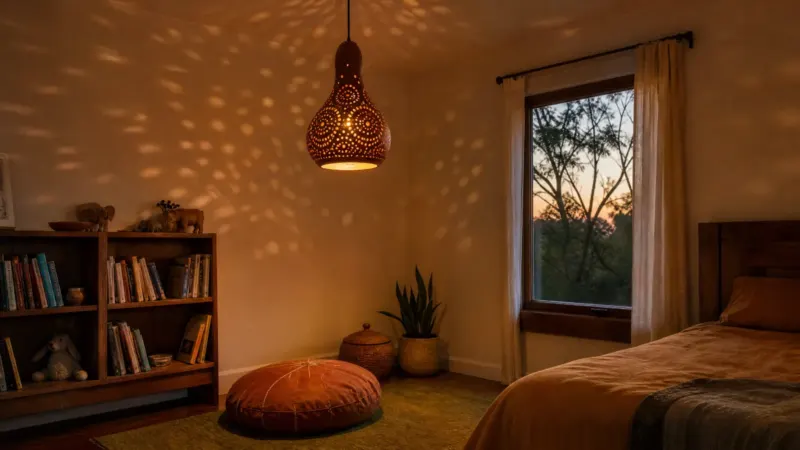
Here is the disclosure. This store makes carved gourd lamps: a dried bottle gourd, sanded, then hand-pierced with hundreds of small holes in a pattern, some of them set with coloured glass beads, mounted on a turned wooden base. Light escapes through the holes and lands on the ceiling and walls as a pattern of points. It is a different craft with a similar visual result, and it has a genuinely different risk profile.
| Glass mosaic | Carved gourd | |
|---|---|---|
| Weight (table size) | 2–5 kg | 0.6–1.2 kg |
| If it falls | Usually a write-off | Usually survives; may dent |
| Light pattern | Coloured fields, softer edges | Sharp points of light, mostly warm white |
| Cleaning | Soft brush, grout traps dust | Dry brush or vacuum on low |
| Colour | Wide — full glass palette | Limited — natural shell plus dye and beads |
| Humidity | Indifferent | Will absorb moisture; no bathrooms |
| Typical price | $45–900 depending on format | $279 flat here |
The honest read: if you want deep coloured light, the kind that pools red or cobalt on a wall, glass mosaic does something a pierced shell cannot. If you want the patterned-shadow effect in a house where things get knocked over, and you would rather not gamble on international glass shipping, the carved version is the lower-anxiety object. The two are not substitutes for each other and anyone telling you otherwise is selling. The side-by-side comparison of gourd and mosaic lamps goes deeper on the visual difference if you are weighing it up.
Neither one is a reading light. You cannot read a paperback by either without straining. Both are second-layer light, added to a room that already has a primary source.
So which should you buy
A short decision path.
- Want coloured light, have a stable surface, buying under $150: a small glass mosaic table lamp, dense cut, from a seller who shows an unlit photo.
- Want coloured light over a dining table: a multi-globe pendant, and check your ceiling box weight rating before you order.
- Want the pattern effect, worried about breakage or shipping: carved shell, table or hanging format.
- Want light you can actually read by: buy neither, buy a proper task lamp, and add one of these afterwards for the atmosphere.
Whatever you land on, put a 2700K LED in it and put felt under it.
Cleaning and long-term care
Grout is porous and it collects household dust, cooking film and, in some homes, candle soot. Left alone for a few years it goes grey and the colours flatten, which people usually blame on the glass.
The method is dry first, wet only if you must. Switch the lamp off and let it cool. Work over the surface with a soft dry paintbrush, following the grout lines rather than across them, with a vacuum nozzle held a few centimetres away to catch what lifts. That is enough twice a year in most homes.
If the grout has genuinely stained, a barely damp cloth on the glass faces only, kept off the grout, will restore most of the colour. Do not soak it, do not use a spray cleaner, and do not put anything abrasive near the fragments, because the edges are what the adhesive grips. Anything that loosens an edge starts the failure described above.
Metal frames need almost nothing. Unlacquered brass will darken over the years and most people prefer it that way. If yours is a sprayed brass-look coating, avoid solvent cleaners entirely, since they take the finish off faster than time does.
The same principles apply to carved shell shades with one difference: no moisture at all. The care guide for carved lamps covers that properly.
Common questions about buying a mosaic lamp
Are mosaic lamps still made by hand in Turkey?
Many are, but the range is wide. Small family workshops still hand-cut and hand-set every fragment. Larger operations use pre-moulded tile and assembly lines. Both ship worldwide and both describe themselves as handmade. The density and edge regularity of the glass in a close-up photo is the most reliable tell.
What bulb should go in a mosaic lamp?
A warm white LED at 2700K, 4 to 6 watts, in the E26 or E27 fitting the lamp came with. A clear filament-style LED throws a slightly sharper pattern than a frosted one. Avoid incandescent bulbs above 25W, since the heat loosens the adhesive holding the glass over time.
Can a mosaic lamp be repaired if pieces fall off?
Yes, if you keep the fragment. A dot of clear silicone adhesive, pressed and left overnight, is usually invisible once dry. A cracked glass globe is not economically repairable and generally means replacing the shade.
How much should a good mosaic lamp cost?
For a small hand-cut table lamp bought direct, roughly $60 to $120 is a fair band. Under $40 almost always means moulded tile and a stamped frame. Over $300 for a single small table lamp usually reflects importer margin rather than extra craft.
Do mosaic lamps give enough light to read by?
No. The coloured glass absorbs most of the output and what escapes is directional and patterned. Treat it as a second layer of light in a room that already has a main source, not as a replacement for one.
If the carved-shell route is the one that fits your house, the gourd table lamps and the gourd chandeliers and pendant lights are all made to order and ship worldwide with shipping included. If glass mosaic is what you are after, take the checklist above to whichever seller you end up with.